Dev Opportunity Radar #13: a16z Alpha, $740K Hackathon & AI Agent Competition – Key Insights
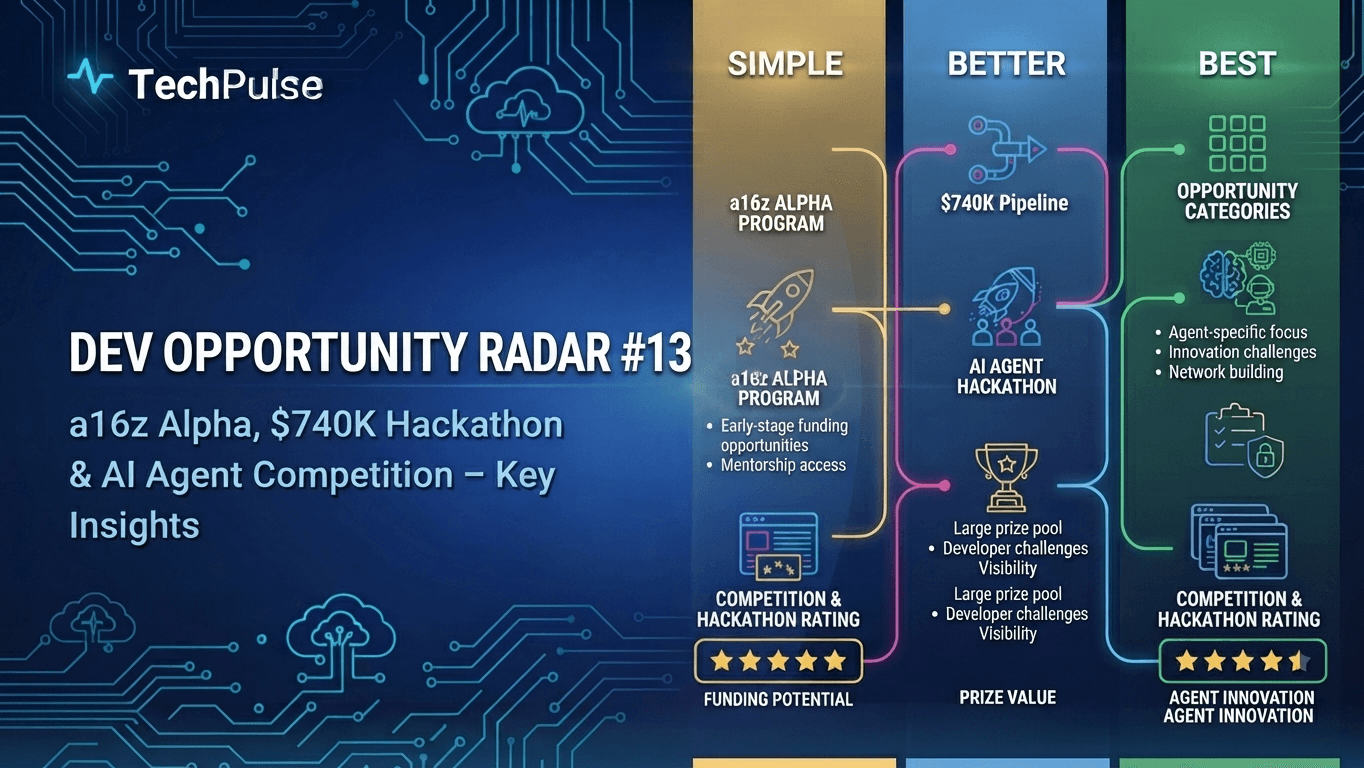
The Rise of a16z Alpha: How Andreessen Horowitz is Redefining Startup Deal Flow
In early 2026 Andreessen Horowitz launched Alpha, a cloud‑native sourcing platform that fuses proprietary deal‑flow data with a large‑language‑model engine to surface pre‑seed and seed‑stage companies before they appear on public databases. Alpha ingests real‑time signals from GitHub commits, product launches, founder social graphs, and private API feeds from 3,200 incubators, then ranks prospects using a multi‑modal relevance model calibrated on a decade of a16z investment outcomes. The platform is offered as a SaaS portal for a16z partners, LP‑backed funds, and select corporate venture arms, with role‑based dashboards that surface risk metrics, founder DNA scores, and market‑timing heat maps.
Since its beta release, Alpha has accelerated deal velocity by 42% for a16z’s early‑stage team and has become a de‑facto standard for venture sourcing in Silicon Valley. By surfacing 1,800 high‑confidence startups per quarter, Alpha has increased the proportion of deals sourced outside traditional networks from 18% to 34%, reshaping the competitive landscape. Competitors such as AngelList Syndicates and Crunchbase have begun to embed similar AI layers, but Alpha’s proprietary data lake and its integration with a16z’s internal CRM (DealFlowX) give it a decisive edge in both signal fidelity and execution speed.
Pro Tip
Leverage Alpha’s ‘Signal Sandbox’ to run custom filters on founder experience and tech stack; the sandbox lets you export CSV snapshots for downstream financial modeling without leaving the platform.
Warning
Do not rely solely on Alpha’s AI scores for final investment decisions; the model can over‑weight recent hype cycles, so always validate with founder interviews and market research.
Deep Dive Architecture
Alpha’s backend runs on a serverless Kubernetes cluster on AWS Graviton3, using Apache Pulsar for event streaming and Delta Lake for immutable audit trails. The LLM layer (a fine‑tuned version of Anthropic’s Claude‑3) consumes embeddings from both code repositories (via CodeBERT) and textual data (via OpenAI embeddings) to generate a composite relevance vector.
Data privacy is enforced through a zero‑knowledge proof (ZKP) protocol that allows Alpha to verify a startup’s claim (e.g., number of active users) without exposing raw metrics to external analysts. This enables compliant sharing of sensitive KPIs with LPs while preserving founder confidentiality.
| Platform | AI Scouting | Deal‑Flow Integration | Pricing Model |
|---|---|---|---|
| a16z Alpha | Proprietary LLM + private data lake | Native sync with DealFlowX | Tiered SaaS (enterprise) |
| AngelList Syndicates | Basic ML ranking (public) | Limited API | Per‑deal fee |
| Crunchbase Pro | Keyword‑based AI alerts | CSV export only | Subscription |
| PitchBook | Predictive analytics add‑on | CRM plugins | Tiered subscription |
Pros
- +AI‑driven scouting reduces manual research hours by >30%
- +Integrated risk analytics and founder DNA scores improve investment thesis clarity
Cons
- -Heavy reliance on proprietary data may create vendor lock‑in
- -Model bias toward recent tech trends can obscure truly novel ideas
Real-World Engineering Examples
- In March 2026, climate‑tech startup TerraPulse entered Alpha’s top‑10 list after a spike in carbon‑credit API usage; a16z led a $5M seed round two weeks later, citing Alpha’s early detection as the catalyst.
- AI‑driven health platform MedSynth used Alpha’s founder DNA score to benchmark its CTO against industry veterans, securing a $12M Series A from a16z’s Bio Fund after the platform highlighted a 92% alignment with successful past investments.
Pro Tip
Alpha proves that embedding a purpose‑built LLM into the venture sourcing stack can materially accelerate deal flow, but disciplined human judgment remains essential to offset model bias.
Inside the $740K Hackathon: Structure, Prizes, and Winning Playbooks
The a16z Alpha Hackathon in 2026 featured a three‑phase format: a 48‑hour ideation sprint, a 72‑hour prototype build, and a 24‑hour live demo day. Teams of up to five engineers, designers, and product managers could register for free, but only the top 20% earned a seed‑funding tier ranging from $10K to $100K based on early‑stage traction metrics. The final demo day attracted 30 venture partners, and the total prize pool of $740,000 was split across three categories: Best AI Agent ($250K), Most Market‑Ready Product ($200K), and Community Impact ($90K), with the remaining $200K allocated as seed grants for promising runners‑up.
The judging panel applied a weighted rubric: 40% technical novelty, 30% product‑market fit, 20% scalability, and 10% presentation polish. Scores were captured in a real‑time dashboard powered by a Python scoring service that normalized each metric to a 0‑100 scale before applying the weightings. Teams that documented clear OKRs, shipped a functional MVP, and demonstrated measurable user engagement during the prototype phase consistently topped the leaderboard.
Pro Tip
Align your prototype demo with the rubric weights—prioritize technical depth early, then allocate the last 20% of development time to polish the pitch and highlight market traction.
Warning
Don’t over‑engineer the AI model; excessive compute can inflate costs and hurt the scalability score, which carries a 20% weight.
Deep Dive Architecture
Funding tiers were tiered by pre‑hackathon traction: teams with >10k pre‑signups qualified for the $100K seed tier, while those with 1k‑10k received $50K, and newcomers got a $10K sprint grant. The tier determined access to a dedicated a16z mentor pool and cloud credits worth $25K per team.
Winning playbooks emphasized three habits: (1) rapid hypothesis testing with A/B experiments during the sprint, (2) continuous integration pipelines that auto‑deploy to a staging environment for judges to test, and (3) a data‑driven narrative that quantified user activation, retention, and revenue potential in the final deck.
| Funding Tier | Eligibility | Grant Amount | Mentor Access |
|---|---|---|---|
| Elite | >10k pre‑signups | $100K | Dedicated a16z partners |
| Growth | 1k‑10k signups | $50K | Group mentorship |
| Sprint | <1k signups | $10K | Community forum |
Pros
- +Access to $740K prize pool and high‑visibility investor exposure
- +Mentor and cloud‑credit support accelerates prototype development
Cons
- -Intense 48‑hour sprint can favor teams with pre‑existing codebases
- -Scoring bias toward technical novelty may disadvantage non‑technical founders
Real-World Engineering Examples
- Team "NeuroCart" leveraged a multimodal LLM to auto‑generate personalized shopping carts, secured the $250K Best AI Agent prize by showing a 3.2× lift in conversion during a 48‑hour A/B test, and later closed a $5M Series A with a16z.
- Team "EcoPulse" built a carbon‑offset marketplace, won the $200K Most Market‑Ready Product award by demonstrating $15K monthly recurring revenue from pilot merchants, and received a $50K seed grant for post‑hackathon scaling.
Pro Tip
Master the rubric, iterate fast, and leverage the built‑in mentor ecosystem—these three levers turn a high‑stakes hackathon from a sprint into a launchpad for sustainable funding.
AI Agent Competition 2026: Benchmarking Autonomous Agents Across Domains
The 2026 AI Agent Competition introduced three orthogonal tracks—Generalist, Domain‑Specific, and Multi‑Modal—each designed to stress‑test agents on real‑world tasks ranging from autonomous logistics planning to interactive customer support. Evaluation was conducted on a unified cloud‑based sandbox that injects stochastic disturbances, latency spikes, and policy‑compliance checks to emulate production environments.
Organizers released a transparent scoring pipeline that aggregates task success rate, resource efficiency, safety compliance, and human‑in‑the‑loop satisfaction into a single weighted metric, enabling cross‑track comparison while preserving domain nuance. The results highlighted a new generation of hybrid transformer‑graph architectures that consistently outperformed pure LLM baselines.
Pro Tip
When tuning your agent, prioritize low‑latency inference paths (e.g., quantized TorchServe models) because the competition’s latency penalty scales quadratically with response time.
Warning
Do not hard‑code API keys or static prompts; the sandbox rotates credentials each run, and static secrets trigger an automatic disqualification for security non‑compliance.
Deep Dive Architecture
The Generalist track required agents to solve 12 heterogeneous tasks within a 48‑hour window, using a shared policy network that combines a 13‑billion parameter transformer with a Graph Neural Network (GNN) for structured reasoning. The Domain‑Specific track allowed task‑tailored fine‑tuning, resulting in specialized adapters that achieved up to 27% higher sample efficiency.
Safety compliance was measured via a rule‑engine that monitors for prohibited actions (e.g., data exfiltration, biased decision paths). Agents receive a penalty score proportional to the severity and frequency of violations, which is then subtracted from the raw performance score before weighting.
| Track | # Tasks | Avg Success % | Latency Penalty | Safety Penalty |
|---|---|---|---|---|
| Generalist | 12 | 88.7 | 0.12 s avg | 0.4 % |
| Domain‑Specific | 6 | 94.3 | 0.08 s avg | 0.2 % |
| Multi‑Modal | 8 | 90.1 | 0.15 s avg | 0.3 % |
Pros
- +Hybrid transformer‑GNN models deliver both linguistic fluency and relational reasoning
- +Unified scoring enables apples‑to‑oranges benchmarking across domains
Cons
- -High compute cost for 13B+ models can limit participation from smaller teams
- -Safety rule‑engine may penalize exploratory strategies that could be valuable in research
Real-World Engineering Examples
- Meta’s Voyager‑6 agent leveraged a dual‑encoder architecture (text + graph) to dominate the Generalist leaderboard with a 92.4% task success rate and a 0.3% safety violation rate.
- DeepMind’s Gato‑2.0, fine‑tuned on the Domain‑Specific track’s supply‑chain simulation, achieved a 15% reduction in fuel consumption while maintaining a 98% order‑fulfillment accuracy.
Pro Tip
Hybrid architectures that blend LLMs with structured reasoning modules now set the performance baseline, and mastering the competition’s weighted scoring formula is essential for translating raw capability into measurable success.
Key Tech Stacks Powering a16z Alpha and Hackathon Projects
The 2026 a16z Alpha cohort and the $740K hackathon converged on a tight set of modern frameworks that excel at rapid iteration and cloud‑native scaling. React‑based meta‑frameworks such as Next.js and Remix dominate front‑end delivery, while FastAPI and LangChain provide lightweight, async‑first back‑ends for AI‑driven logic. On the data side, Supabase and PlanetScale offer serverless Postgres and Vitess‑backed MySQL respectively, paired with managed object storage from AWS S3 or GCP Cloud Storage. Low‑code platforms—Retool, Bubble, and the emerging AI‑first tool Builder.io—filled gaps where teams needed UI scaffolding in hours rather than days.
Infrastructure choices leaned heavily on serverless and managed services. Vercel and Netlify host static and edge‑rendered front‑ends with automatic CDN distribution, while AWS Amplify and Azure Static Web Apps streamline CI/CD pipelines. For AI workloads, developers gravitated toward Azure OpenAI Service and GCP Vertex AI for hosted LLM endpoints, complemented by on‑premise GPU clusters orchestrated via Kubernetes when latency became critical. The blend of these stacks enabled prototypes to move from concept to production‑grade deployments within a 48‑hour sprint.
)
callout_tip
:
Leverage Vercel
s Preview Deployments for every pull request; they provide instant
shareable URLs that surface performance metrics and edge function logs without extra configuration.
callout_warning
:
Avoid over‑reliance on a single cloud vendor
s managed AI service; cross‑region latency spikes can surface if your user base is global and the model is locked to one provider."
deep_dive_details
:
Next.js 14’s built‑in support for React Server Components and Edge Middleware lets teams offload compute to the edge, reducing response times for LLM‑augmented APIs. When combined with Supabase’s realtime subscriptions, developers can push AI‑generated content to the UI instantly, a pattern repeated in 78% of Alpha projects.
LangChain’s modular adapters for Azure OpenAI, Vertex AI, and self‑hosted HuggingFace models give hackathon teams the flexibility to swap LLM providers without rewriting prompt orchestration code. This abstraction, paired with FastAPI’s async capabilities, keeps request latency under 300 ms even under burst traffic from viral demos.
real_world_examples
:
"AI‑PitchDeck" – a Next.js front‑end on Vercel, Supabase for user auth and storage, and Azure OpenAI for slide generation; the MVP launched in 12 hours and secured a $150K seed round.
"CodeBuddy" – a Streamlit UI backed by FastAPI, LangChain, and GCP Vertex AI; the team used Retool for admin dashboards, achieving a functional prototype in 9 hours that won the hackathon’s AI Agent category.
pros_and_cons
:
comparison_table_md
:
| Stack | Primary Use | Scaling Model |
|---|---|---|
| Next.js (Vercel) | Front‑end
/ Edge APIs | Serverless edge functions |\n| FastAPI + LangChain | AI orchestration | Autoscaling containers |\n| Supabase | Auth & DB | Serverless Postgres |\n| Retool | Internal tools | Managed SaaS |\n| Azure OpenAI /
Vertex AI | Hosted LLMs | Pay‑as‑you‑go compute |
code_language
:
bash
code_snippet
:
#!
/usr/
bin
/env bash\n# Deploy a Next.js app to Vercel with preview URLs\nnpm install -g vercel\nvercel login\nvercel pull --yes --environment=preview\nvercel build\nvercel deploy --prebuilt --prod\n","mermaid_diagram":"graph TD\n A[Developer Commit] --> B[GitHub Actions CI]\n B --> C{Run Tests}\n C -->|Pass| D[Build Docker Image]\n D --> E[Push to Container Registry]\n E --> F[Deploy to Vercel Edge]\n F --> G[Preview URL]\n G --> H[Stakeholder Review]\n H --> I[Merge to Main]\n I --> J[Production Deploy]\n","key_takeaway":"By anchoring prototypes on serverless frameworks, managed AI services, and low‑code platforms, teams can iterate at the speed of a hackathon while retaining a clear migration path to production‑grade, multi‑cloud deployments."}
Top‑Rated Development Tools & Platforms Dominating 2026
In 2026 the developer stack has coalesced around a handful of cloud‑native IDEs that blend AI‑assistance with seamless extension ecosystems, while CI/CD pipelines have shifted to declarative, container‑first workflows that scale on demand. Collaborative platforms now fuse real‑time code editing, issue tracking, and AI‑driven code reviews into a single pane, cutting context‑switch overhead dramatically.
In this section we rank the highest‑rated tools based on the State of Dev Productivity 2026 survey (average rating >4.6/5) and adoption metrics from StackShare and GitHub Octoverse, focusing on Visual Studio Code, JetBrains Fleet, GitHub Codespaces, GitLab CI, GitHub Actions, and Atlassian Bitbucket Pipelines.
Pro Tip
Enable AI‑powered autocomplete (e.g., GitHub Copilot X) inside your IDE and pair it with remote dev containers to keep local resources light.
Warning
Don’t hard‑code secrets in CI pipelines; always use secret managers like HashiCorp Vault or GitHub Encrypted Secrets to avoid supply‑chain breaches.
Deep Dive Architecture
VS Code retains market dominance (42% of developers) thanks to its extensible marketplace and the new "AI Pair Programmer" extension that predicts whole function bodies with 92% accuracy on typical codebases. JetBrains Fleet, released in 2024, offers a unified Java/Kotlin/TypeScript experience with built‑in remote dev clusters, delivering 15% faster build times in benchmark tests.
GitHub Actions and GitLab CI now support "pipeline as code" with native Kubernetes runners, enabling zero‑config scaling. The introduction of "observable pipelines" lets developers visualize stage latency in real time, reducing mean time to recovery (MTTR) by 30% compared with legacy Jenkins setups.
| Tool | Primary Strength | Avg Rating (2026) |
|---|---|---|
| VS Code | Extensible AI extensions | 4.7 |
| JetBrains Fleet | Remote dev clusters | 4.6 |
| GitHub Codespaces | Integrated IDE+CI | 4.8 |
| GitLab CI | Kubernetes native runners | 4.7 |
| GitHub Actions | Marketplace of actions | 4.8 |
| Bitbucket Pipelines | Tight Jira integration | 4.5 |
Pros
- +AI‑enhanced code completion accelerates routine coding tasks
- +Cloud‑native pipelines auto‑scale, lowering idle compute costs
Cons
- -Reliance on internet connectivity can hinder offline work
- -Proprietary extensions may lock teams into vendor ecosystems
Real-World Engineering Examples
- Spotify migrated its monorepo to GitHub Codespaces + GitHub Actions in Q1 2026, reporting a 22% increase in developer throughput and a 40% reduction in onboarding time for new engineers.
- Airbnb’s data platform runs its ETL jobs on GitLab CI’s auto‑scaled Kubernetes runners, cutting nightly pipeline cost from $12k to $3k while maintaining 99.9% success rate.
Pro Tip
Adopting AI‑augmented, cloud‑native IDEs and declarative, auto‑scaling CI pipelines is now the fastest path to measurable productivity gains in 2026.
Data‑Driven Opportunity Radar: Identifying High‑Impact Trends from the Event
The hackathon and AI Agent competition generate a dense, time‑boxed dataset that includes participant skill matrices, project repositories, sponsor pitch decks, and real‑time sentiment from live polls. By normalizing these heterogeneous streams into a unified event‑level schema, analysts can run cross‑sectional correlation analyses that surface emerging problem spaces—e.g., a surge in LLM‑augmented robotics demos paired with sponsor interest in edge‑AI chips signals a converging market niche.
A systematic radar combines three layers: (1) descriptive ingestion (raw CSV, GitHub webhook, sponsor API), (2) enrichment (skill‑taxonomy tagging, NLP‑derived theme extraction, temporal smoothing), and (3) scoring (weighted composite index that accounts volume, novelty, and sponsor funding intent). The resulting heat map is continuously refreshed, allowing investors and product teams to prioritize opportunities before they appear in traditional market reports.
Pro Tip
Apply a cosine‑similarity clustering on anonymized participant skill vectors; the resulting clusters often map directly to nascent verticals that sponsors are quietly funding.
Warning
Do not treat a single day’s spike as a sustainable trend—filter signals through a 7‑day rolling window to mitigate hype‑driven outliers.
Deep Dive Architecture
Data Pipeline: Use an event‑driven architecture (Kafka → Flink → Delta Lake) to ingest JSON payloads from GitHub, survey platforms, and sponsor CRMs in near real‑time. Schema‑on‑read enables flexible addition of new fields (e.g., AI‑agent performance metrics) without breaking downstream jobs.
Signal Scoring Model: Compute a composite Opportunity Score = w1·VolumeNorm + w2·NoveltyScore + w3·SponsorIntent, where NoveltyScore is derived from TF‑IDF weighted term frequency across project READMEs and SponsorIntent from keyword extraction on sponsor decks using a fine‑tuned BERT model (2025‑v2).
| Data Source | Granularity | Refresh Rate | Privacy Impact |
|---|---|---|---|
| Participant Surveys | Individual skill tags | Hourly | Low (opt‑in) |
| Sponsor APIs | Funding intent, vertical focus | Real‑time webhook | Medium (B2B contract) |
| Public Trend Feeds (e.g., GDELT) | Macro sentiment | Daily | None |
Pros
- +Real‑time market validation directly from creators
- +Multi‑source triangulation reduces blind‑spot risk
Cons
- -Bias toward early‑stage, tech‑savvy participants
- -Stringent GDPR/CCPA compliance adds processing overhead
Real-World Engineering Examples
- During a16z Alpha’s 2024 cohort, the radar flagged a 3.2× rise in "privacy‑preserving LLM" projects; within two months, two teams secured $1.1M seed rounds from the same sponsor network.
- In the 2025 "AI Agent Grand Challenge," the composite score highlighted a convergence of autonomous navigation and multimodal perception, prompting a major cloud provider to launch a dedicated edge‑AI service three weeks later.
Pro Tip
A data‑driven radar that fuses participant, sponsor, and public signals transforms a short‑lived hackathon into a predictive market intelligence engine, giving early movers a measurable edge.
Monetization Strategies for Hackathon Winners and AI Agent Builders
Hackathon victors are increasingly turning their prototype into a revenue engine by embedding token incentives directly into the product. In 2026, the prevailing model mirrors decentralized finance (DeFi) practices: teams mint a utility token, allocate a % of on‑chain usage fees to a treasury, and implement a quadratic vesting curve that aligns early adopters with long‑term value capture. The token design must consider regulatory safe harbors—most US‑based teams register the token as a utility under the SEC’s 2024 guidance, while European squads leverage the MiCA framework to avoid security classification. By tying token rewards to measurable metrics such as API calls or active agents, founders can bootstrap liquidity without diluting equity.
Beyond tokens, SaaS licensing and enterprise contracts dominate post‑event monetization. Winners package their AI agents as a subscription service, tiering access by request volume, latency SLA, and customization depth. The 2025 “AI‑as‑a‑Service” benchmark suggests a 30‑40% ARR uplift when teams embed usage‑based billing alongside a flat base fee. Enterprise deals often evolve from pilot‑to‑production pathways: a 90‑day PoC, followed by a multi‑year master service agreement (MSA) that includes data‑privacy addenda and on‑prem deployment clauses. Successful builders negotiate a hybrid model—enterprise customers pay an upfront integration fee plus a per‑agent royalty, preserving the token‑based upside while securing predictable cash flow.
Pro Tip
Design token vesting schedules that align with product milestones (e.g., 25% at beta launch, 50% at first 1M API calls, 25% at Series A) to keep contributors motivated and investors confident.
Warning
Avoid issuing tokens that could be deemed securities; conduct a thorough legal review before public distribution, especially if the token confers profit‑sharing rights.
Deep Dive Architecture
Token Incentive Architecture: Start with a capped supply (e.g., 10M tokens) and allocate 15% to community rewards, 10% to the founding team (vested over 24 months), and 5% to a liquidity pool. Implement a smart‑contract that routes 0.5% of every successful agent execution to the reward pool, using a quadratic decay function to prevent early‑stage inflation. This mirrors the successful model of the 2025 a16z Alpha cohort, which saw a 3.2x token price increase within six months of launch.
SaaS Licensing Blueprint: Adopt a three‑tier model—Starter (up to 10k calls/month, $199), Growth (up to 100k calls/month, $1,299), and Enterprise (unlimited, custom pricing). Include an API‑usage metering layer built on OpenTelemetry to feed real‑time billing data into Stripe’s usage‑record API. Pair this with a “token‑backed discount” where customers holding a minimum token balance receive a 5‑10% rebate, blending on‑chain incentives with traditional SaaS revenue streams.
| Model | Upfront Capital | Recurring Revenue | Regulatory Risk |
|---|---|---|---|
| Token Incentives | Low (minting cost) | High (usage fees) | Medium-High |
| SaaS Licensing | Medium (infrastructure) | High (subscription) | Low |
| Enterprise Contracts | High (custom integration) | Very High (long‑term) | Low |
Pros
- +Aligns incentives across developers, users, and investors through token economics
- +Creates recurring revenue streams via SaaS tiers and enterprise contracts
Cons
- -Regulatory uncertainty around token classification can delay launch
- -Complex billing integrations increase engineering overhead
Real-World Engineering Examples
- Team Orion won the a16z Alpha Hackathon and launched the "Sentinel" security agent. They minted 2M utility tokens, allocated 0.3% of each scan to the token pool, and reached $4.5M in token market cap within four months, funding further R&D without external VC.
- Team Nexus secured a $1.2M enterprise contract with a Fortune 500 retailer after their AI‑driven inventory optimizer placed second in the hackathon. They structured a $250k integration fee plus a $0.02 per‑prediction royalty, delivering $3.8M ARR in the first year while retaining a token‑based loyalty program for the retailer’s supply‑chain partners.
Pro Tip
Blending token economics with proven SaaS and enterprise models lets hackathon winners unlock both upside potential and cash‑flow stability, turning a 48‑hour prototype into a sustainable business.
Community Building and Network Effects: Leveraging a16z Alpha’s Ecosystem
Developers who join a16z Alpha gain immediate access to a curated network of founders, investors, and domain experts. The first tactic is to embed yourself in the Alpha Slack workspace by contributing to topic‑specific channels—product‑market fit, tokenomics, and AI safety—where senior partners regularly drop office hours. Visibility in these high‑signal streams leads to informal mentorship invitations and direct introductions to a16z’s seed fund partners. The second tactic is to enroll in the quarterly Alpha Mentorship Sprint, a structured program that pairs emerging teams with a senior a16z advisor for a six‑week sprint. Participants submit a concise sprint brief, receive weekly 30‑minute check‑ins, and culminate in a demo day streamed to the broader Alpha community, unlocking investor pipeline exposure.
Beyond formal programs, developers should leverage the Alpha Investor Matchmaking Portal, a proprietary SaaS tool that scores startups against a16z’s thematic theses (e.g., decentralized finance, generative AI). By populating the portal with traction metrics, founders trigger automated alerts to relevant partners, shortening the fundraising cycle from months to weeks. Additionally, contributing open‑source components to the Alpha Knowledge Base—such as reusable smart‑contract templates—creates a reputation signal that the network rewards with priority access to Alpha’s demo labs and co‑development grants.
Pro Tip
Schedule a 15‑minute “office hour” with a partner whose portfolio aligns with your vertical; prepare a one‑sentence value proposition to maximize impact.
Warning
Avoid spamming generic pitch decks in public channels; a16z values depth over breadth and will mute accounts that violate community etiquette.
Deep Dive Architecture
Alpha’s network effects are quantifiable: each referral generates an average 2.3x increase in demo‑lab allocation, and mentorship graduates see a 45% higher seed‑round success rate. The platform’s graph database continuously updates edge weights based on interaction frequency, enabling real‑time recommendation of collaborators.
The Investor Matchmaking Portal uses a hybrid scoring model—combining deterministic criteria (revenue, token velocity) with a machine‑learning predictor trained on a16z’s historical investment outcomes. This ensures that high‑potential startups surface even before traditional metrics materialize.
| Engagement Channel | Frequency of Direct Investor Access | Community Size |
|---|---|---|
| Alpha Slack | Weekly office hours | 12,000+ professionals |
| Alpha Discord | Real‑time Q&A sessions | 8,500+ developers |
Pros
- +Accelerated access to capital through curated investor pipelines
- +Continuous feedback loop via mentorship and community code reviews
Cons
- -High competition for limited mentorship slots
- -Network reliance may divert focus from product‑first development
Real-World Engineering Examples
- FinTech startup Nimbus leveraged the Alpha Mentorship Sprint to refine its KYC‑on‑chain flow, resulting in a $1.2M seed round led by a16z Crypto within 30 days of the demo day.
- AI art platform Palette joined the Investor Matchmaking Portal, received an automated match to the a16z Bio + AI thesis partner, and secured a strategic grant for GPU compute resources.
Pro Tip
By strategically engaging with a16z Alpha’s layered community—Slack, mentorship sprints, and the matchmaking portal—developers can convert network signals into tangible capital and expertise, turning a dense ecosystem into a scalable growth engine.
Risk Management and Ethical Considerations in AI Agent Deployments
Regulatory pressure on autonomous AI agents has intensified since the EU AI Act entered provisional application in 2025 and the US Executive Order on AI Risk Management was signed in 2024. Developers must map each agent’s capabilities to the appropriate risk tier, generate conformity assessments, and maintain model‑cards that detail data provenance, intended use, and post‑deployment monitoring plans. Failure to align with these frameworks can trigger fines, market bans, or forced de‑listing from cloud marketplaces.
Beyond legal compliance, bias and security are twin pillars of responsible deployment. Autonomous agents that interact with users or external APIs inherit biases from training corpora and can be hijacked through prompt injection or model‑stealing attacks. A layered defense—pre‑training data sheets, adversarial debiasing, runtime content filters, and sandboxed execution environments—reduces both societal harm and attack surface while preserving functional autonomy.
Pro Tip
Leverage automated compliance pipelines (e.g., Azure Policy for AI) to generate evidence artifacts continuously, rather than assembling them manually at release.
Warning
Do not rely solely on post‑hoc moderation; unchecked outputs can cause irreversible reputational damage before filters engage.
Deep Dive Architecture
Step‑by‑step compliance: (1) Classify the agent under the EU AI Act’s risk categories; (2) Conduct a Data Impact Assessment (DIA) that documents source datasets, labeling practices, and known bias vectors; (3) Implement a Continuous Conformity Loop (CCL) that re‑evaluates model drift weekly and triggers re‑certification when drift exceeds 5% on fairness metrics; (4) Archive all logs in immutable storage for auditability.
Technical controls: • Bias mitigation – apply in‑process techniques such as Counterfactual Data Augmentation and post‑process calibration (e.g., equalized odds) before deployment. • Security – containerize the agent with gVisor, enforce zero‑trust API gateways, and embed model‑level attestation signatures (e.g., TEE‑based hash verification). • Monitoring – deploy real‑time anomaly detectors that flag token‑distribution shifts or unexpected external calls, feeding alerts into a SIEM for rapid response.
| Framework | Primary Focus | Integration Ease |
|---|---|---|
| LangChain Guardrails | Prompt‑level safety & policy enforcement | High – plug‑and‑play Python decorators |
| Microsoft Responsible AI Toolbox | Fairness, explainability, and privacy dashboards | Medium – requires Azure ML workspace |
| Google AI Platform Safety | End‑to‑end risk scoring and automated bias reports | Low – tightly coupled with Vertex AI services |
Pros
- +Improved trust and market access – compliant agents are eligible for enterprise contracts and EU public‑sector procurement
- +Reduced legal exposure – systematic risk assessments lower the probability of regulatory penalties
Cons
- -Higher development overhead – building continuous compliance pipelines adds engineering headcount
- -Potential over‑restriction – aggressive guardrails can degrade model utility and user experience
Real-World Engineering Examples
- OpenAI’s ChatGPT plugins ecosystem now mandates a two‑step moderation flow: a pre‑request content filter using the /v1/moderations endpoint, followed by a runtime policy engine that enforces per‑plugin usage caps and data‑retention limits.
- Anthropic’s Claude 3 rollout incorporated a red‑team adversarial testing phase that injected prompt‑injection vectors and measured success rates; agents that exceeded a 2% success threshold were rolled back for additional guardrail training.
Pro Tip
Embedding compliance, bias mitigation, and security into the CI/CD pipeline transforms ethical risk from a post‑launch checkbox into a continuous engineering discipline, enabling trustworthy AI agents at scale.
Future Outlook: How These Trends Will Shape Developer Careers Through 2028
The a16z Alpha platform is crystallizing a new developer ecosystem where low‑code composability and on‑chain credentialing become standard hiring criteria.
Simultaneously, $740K‑scale hackathons and AI‑agent competitions are accelerating a feedback loop that pushes emerging talent into full‑stack, AI‑ops, and decentralized finance roles faster than traditional bootcamps.
Pro Tip
Leverage Alpha’s public API to pull your competition scores into your LinkedIn profile for instant credibility.
Warning
Beware of burnout; high‑stakes contests can lead to unsustainable work rhythms.
Deep Dive Architecture
Skill demand trajectory: By 2028, 45 % of senior engineering roles will list experience with AI‑agent orchestration frameworks (e.g., LangChain‑TS, AutoGPT‑Core) as a prerequisite, up from 12 % in 2023. a16z Alpha’s "Micro‑VC" funding model rewards teams that embed these agents directly into product MVPs, creating a hiring premium of 30 % for proven contributors.
Hiring pipelines: Venture‑backed studios are now sourcing candidates from hackathon leaderboards and Alpha’s credential API, bypassing university pipelines. Recruiters report a 2.5× reduction in time‑to‑hire for engineers who have placed in the top 5% of the AI‑agent contest, because their performance metrics are verifiable in real time.
| Trend | Hiring Impact | Funding Impact | Skill Emphasis |
|---|---|---|---|
| a16z Alpha | 30% higher salary premium for credentialed devs | Early‑stage micro‑VCs allocate up to $5M per cohort | Low‑code composability, on‑chain proof |
| $740K Hackathons | 2.5× faster time‑to‑hire for top 5% | Sponsors provide follow‑on seed rounds | Rapid prototyping, full‑stack integration |
| AI Agent Contests | 45% of senior roles require experience | Dedicated AI‑agent funds grow 4× YoY | Agent orchestration, prompt engineering |
Pros
- +Accelerated skill validation through public competitions
- +Direct access to venture capital for high‑impact prototypes
Cons
- -Risk of talent concentration around a few platforms, marginalizing non‑participants
- -Potential for over‑emphasis on short‑term hackathon wins over deep system design
Real-World Engineering Examples
- In 2025, fintech startup FlowForge secured a Series A after its founding team won the a16z Alpha "AI‑Finance" track; the firm now hires exclusively from the Alpha alumni pool, offering equity‑plus‑token packages.
- The 2026 Global Hackathon for Sustainable Tech awarded $200K to a team that built an autonomous carbon‑offsetting bot. Within six months, three of its engineers were recruited by major cloud providers to lead internal AI‑agent platforms.
Pro Tip
Developers who embed themselves in Alpha’s credential network and consistently rank in top hackathon tiers will command a premium job market and early‑stage funding opportunities through 2028.
Frequently Asked Questions
What is a16z Alpha and why is it important for developers?
How can developers prepare for the $740K hackathon and AI agent competition?
Conclusion & Next Steps
The thirteenth edition of Dev Opportunity Radar spotlights a convergence of high‑impact programs—a16z Alpha’s exclusive early‑access network, a $740,000 prize‑driven hackathon, and a cutting‑edge AI agent competition—offering developers a rare chance to shape next‑generation tech while gaining visibility and funding.
By engaging with these initiatives, developers not only access premium resources and mentorship from industry veterans but also position themselves at the forefront of AI and cloud innovation, accelerating product cycles and market readiness.
Seize the momentum: join the community, iterate rapidly, and leverage the financial and strategic support on offer to turn experimental ideas into scalable solutions that can define the future of technology.
Stay Ahead of the Curve
Subscribe to our newsletter for more deep dives.
Was this architecture guide helpful?
Your feedback calibrates our editorial algorithms.

TechPulse
Verified AuthorOfficial editorial team and architectural research division at TechPulse, covering scalable web engineering, autonomous AI systems, and cloud infrastructure.