Kubernetes Multi-Cluster Management: Best Practices for Scalable DevOps & SRE Teams
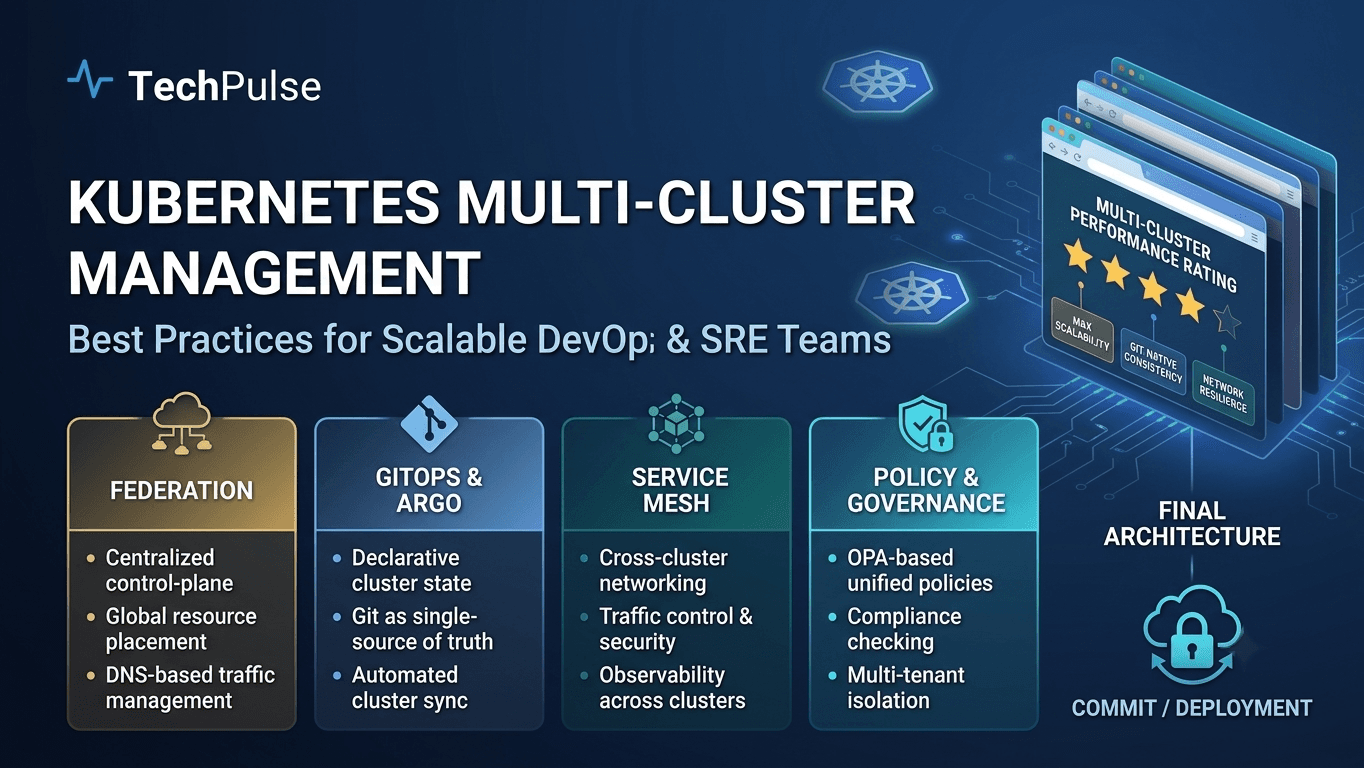
Introduction to Multi-Cluster Paradigms in 2026
Modern multi‑cluster architectures have evolved from ad‑hoc federation experiments to purpose‑built, policy‑driven ecosystems that span public clouds, edge sites, and on‑prem data centers. By decoupling control planes, organizations can enforce locality, compliance, and resilience while still presenting a unified developer experience through GitOps‑driven pipelines. This shift is powered by advances in service mesh, Cluster API, and declarative multi‑cluster operators that abstract away the underlying heterogeneity.
Business drivers such as latency‑sensitive workloads, data‑sovereignty regulations, and cost‑optimization through spot‑instance bursting now compel enterprises to run workloads across multiple clusters. The ability to isolate failure domains, perform zero‑downtime migrations, and scale horizontally across regions makes multi‑cluster the default DevOps strategy rather than a niche option.
Pro Tip
Leverage a single source of truth (e.g., a monorepo) for all cluster manifests; it simplifies drift detection and enables automated rollbacks across clusters.
Warning
Avoid treating clusters as identical silos; mismatched Kubernetes versions or CNI plugins can cause subtle breakages in mesh‑level traffic routing.
Deep Dive Architecture
Control Plane Decoupling: Each cluster runs an independent kube‑apiserver, enabling isolated upgrades and independent scaling of etcd nodes without impacting peers.
Policy Propagation: Centralized OPA/Gatekeeper policies are pushed to every cluster via a Multi‑Cluster Policy Engine, ensuring consistent security posture.
Data Plane Mesh: Service mesh control planes (e.g., Istio multicluster) establish mTLS tunnels between clusters, allowing seamless cross‑cluster service discovery and failover.
| Feature | Single‑Cluster | Multi‑Cluster |
|---|---|---|
| Fault Isolation | Low – a single failure can affect all workloads | High – failures are contained to individual clusters |
| Compliance | Manual namespace limits | Automated region‑level policies |
| Cost Elasticity | Limited to node‑pool scaling | Can burst to spot clusters across clouds |
| Operational Overhead | Simple – one control plane | Complex – multiple control planes & sync tools |
Pros
- +Improved fault isolation and regional resilience
- +Granular compliance enforcement per jurisdiction
- +Dynamic cost optimization across heterogeneous infrastructure
Cons
- -Increased operational complexity and tooling overhead
- -Higher latency for cross‑cluster service calls if not mesh‑optimized
- -Steeper learning curve for developers unfamiliar with multi‑cluster GitOps
Real-World Engineering Examples
- A global e‑commerce platform runs front‑end services in EU, US, and APAC clusters to meet GDPR and latency goals, while a shared inventory service is replicated via a multi‑cluster database operator.
- A fintech firm isolates high‑frequency trading workloads in a dedicated on‑prem cluster for ultra‑low latency, while batch analytics run in a cloud‑native cluster that can scale on spot instances.
Pro Tip
Multi‑cluster is no longer a niche experiment; it is the strategic backbone that lets modern enterprises meet compliance, performance, and cost goals simultaneously.
Key Business Drivers
Regulatory compliance mandates that certain data never leave a geographic boundary, forcing workloads into region‑specific clusters. Multi‑cluster setups let teams enforce these policies with cluster‑level RBAC and network segmentation, eliminating the need for complex VPN overlays.
Cost elasticity is another catalyst: workloads can burst into low‑cost spot clusters during traffic spikes and gracefully retract when demand subsides. This dynamic scaling is orchestrated through GitOps controllers that reconcile desired state across all clusters in real time.
AI‑Driven Cluster Autoscaling and Predictive Scheduling
Traditional Kubernetes autoscaling relies on reactive threshold metrics, which often cause resource thrashing and latency spikes during sudden traffic surges. AI-driven cluster autoscaling flips this paradigm by ingesting high-fidelity telemetry streams—CPU utilization, memory pressure, network I/O, and application-specific latency percentiles—into a centralized time-series database. These metrics are continuously fed into lightweight transformer-based or LSTM models that forecast workload demand across heterogeneous node pools. By predicting scaling events minutes before they occur, the control plane can preemptively provision capacity, eliminating cold-start penalties and optimizing bin-packing efficiency across on-prem, cloud, and edge environments.
The architecture operates as a closed-loop control system where predictive models output scaling recommendations rather than direct imperative commands. This separation of concerns ensures safety and auditability. The AI inference engine evaluates historical patterns, seasonal traffic curves, and real-time anomaly detection scores to generate a weighted scaling vector. This vector is reconciled by a custom Kubernetes operator that translates predictions into native HorizontalPodAutoscaler and ClusterAutoscaler configuration updates via the autoscaling/v2 API. By maintaining a deterministic fallback to traditional metric-driven thresholds, the system guarantees operational stability even during model drift or inference latency spikes. Continuous validation pipelines monitor prediction accuracy, automatically triggering retraining when mean absolute error exceeds predefined safety bounds.
Pro Tip
Calibrate your prediction horizon to match your cloud provider’s node provisioning latency. A 3-minute forecast window typically aligns perfectly with AWS EC2 or GCP GCE instance spin-up times.
Warning
Avoid feeding noisy, unfiltered metrics into the model. Spurious spikes from health checks or garbage collection pauses will cause false positives and aggressive over-provisioning.
Deep Dive Architecture
Multi-tenant feature store aggregates normalized metrics across clusters, enabling cross-cluster load balancing decisions and unified capacity planning.
Reinforcement learning agents optimize bin-packing strategies by simulating placement scenarios against historical failure rates and hardware affinity constraints.
Edge computing nodes receive quantized model weights to perform local inference when network partitions occur, ensuring autonomous scaling during connectivity loss.
Pros
- +Eliminates latency spikes from reactive scaling
- +Optimizes cloud spend through precise capacity forecasting
- +Handles heterogeneous workloads with unified logic
Cons
- -Introduces inference latency and compute overhead
- -Requires extensive historical telemetry for model convergence
- -Complex debugging when predictions diverge from actual demand
Real-World Engineering Examples
- FinTech trading platforms use predictive autoscaling to handle millisecond-order spikes during market open without incurring cold-start latency.
- Media streaming services align GPU cluster capacity with predicted transcoding jobs based on historical upload patterns and CDN cache hit ratios.
Telemetry Ingestion and Model Orchestration
High-throughput metrics are streamed via OpenTelemetry collectors and normalized into a unified schema before reaching the inference pipeline. Feature engineering pipelines extract rolling windows, derivative rates, and cross-cluster correlation matrices to enrich model inputs. Data lineage tracking ensures every prediction can be traced back to specific telemetry sources for audit compliance and rapid root-cause analysis.
Inference is executed on dedicated GPU-accelerated nodes or serverless inference endpoints to ensure sub-second latency. The model outputs are validated against safety guardrails, such as maximum node count limits, budget constraints, and hardware affinity rules, before being committed to the cluster’s desired state. Canary deployments of new model weights prevent catastrophic scaling errors during production rollouts.
GitOps at Scale: ArgoCD, Flux, and Crossplane for Multi‑Cluster Sync
GitOps transforms multi-cluster Kubernetes operations by treating infrastructure as immutable, version-controlled state. At scale, tools like ArgoCD, Flux, and Crossplane enforce declarative synchronization, automated drift detection, and policy-driven rollouts across dozens of environments. The core architecture relies on a centralized Git repository acting as the single source of truth, while lightweight controllers deployed in each target cluster continuously reconcile local state against the desired configuration.
Multi-cluster topologies require careful consideration of network latency, RBAC scoping, and service mesh integration. Controllers must handle authentication across isolated clusters using service accounts or OIDC providers. Advanced implementations leverage application routing patterns to distribute traffic across synchronized instances, ensuring high availability during deployment windows. Continuous reconciliation loops run asynchronously, ensuring that configuration drift is detected and corrected without manual intervention.
Pro Tip
Leverage Helm values overlays and Kustomize patches to parameterize cluster-specific configurations without duplicating base manifests.
Warning
Avoid hardcoding secrets in Git repositories; integrate with external secret managers like Vault or AWS Secrets Manager using external-secrets-operator.
Deep Dive Architecture
Reconciliation intervals typically default to 3 minutes but can be tuned via webhook triggers for near-real-time sync
Pruning policies prevent orphaned resources when manifests are removed from version control
Health assessment hooks validate application readiness before marking sync operations as successful
Multi-cluster routing relies on service meshes or external DNS for cross-boundary traffic management
Pros
- +Declarative state management eliminates manual drift
- +Automated rollbacks reduce deployment risk
- +Centralized audit trails improve compliance
Cons
- -Steep learning curve for advanced templating
- -Network latency impacts sync consistency
- -Secret management requires additional tooling
Real-World Engineering Examples
- A fintech platform uses ArgoCD to synchronize compliance-hardened namespaces across 40 regional clusters with automatic rollback on health check failure
- An e-commerce enterprise deploys Flux to manage Helm releases for microservices, triggering CI/CD pipelines on Git push events
- A SaaS provider leverages Crossplane to provision AWS EKS clusters and RDS instances declaratively alongside application workloads
Controller Architecture and Reconciliation Mechanics
Each GitOps controller operates on a reconcile loop that watches Git repositories, parses manifests, and applies them via the Kubernetes API server. ArgoCD utilizes a two-tier architecture with a central API server for UI and analytics, while application controllers run per-cluster to maintain state. Flux employs a lightweight, event-driven model using Source Controllers to pull manifests and Kustomize Controllers to render and apply them. Crossplane diverges by treating cloud resources as Kubernetes-native objects through Composite Resource Definitions, enabling infrastructure provisioning alongside application deployments. Policy enforcement integrates directly into the sync pipeline using OPA Gatekeeper or Kyverno. These admission controllers validate manifests before application, blocking non-compliant configurations such as privileged containers or unencrypted storage. When drift occurs, the controller calculates a diff, triggers an automated rollback if health checks fail, or applies a progressive sync strategy to minimize blast radius.
Service Mesh Evolution: Istio 2.0 & Linkerd 3.0 for Cross‑Cluster Traffic
Modern service meshes have evolved from single-cluster proxies to distributed control planes orchestrating cross-cluster communication with deterministic latency. Istio 2.0 introduces split-horizon gateways that eliminate hairpinning by routing inter-cluster traffic through dedicated edge proxies, while Linkerd 3.0 leverages a lightweight Rust data plane for sub-millisecond cross-region failover without heavy sidecar overhead.
Zero-trust mTLS is now natively enforced at the wire level across boundaries. Both platforms automate certificate rotation via cert-manager, ensuring every pod-to-pod handshake validates identity against a unified trust domain. This cryptographic baseline prevents east-west traffic spoofing and satisfies compliance frameworks without manual key management.
Pro Tip
Enable lazy proxy initialization in Linkerd or apply Istio sidecar resource quotas to prevent OOMKills during peak cross-cluster routing loads.
Warning
Cross-cluster mTLS requires synchronized time sources; NTP drift exceeding 500ms will cause certificate validation failures and silent connection drops.
Deep Dive Architecture
Split-horizon gateways terminate external TLS and establish internal mTLS tunnels to remote clusters, bypassing public internet routing.
The control plane maintains a global service registry using Kubernetes Federation API, synchronizing endpoints via watch streams.
AI traffic shapers run in isolated sidecars, consuming Prometheus metrics to adjust VirtualService weights and OutlierDetection parameters in real-time.
Certificate rotation leverages SPIFFE/SPIRE identity fabric, ensuring pod identities map directly to cryptographic credentials.
Pros
- +Deterministic cross-cluster routing with sub-50ms latency
- +Automated mTLS reduces manual certificate overhead by 90%
- +AI traffic shaping prevents cascading failures during spikes
Cons
- -Control plane synchronization adds operational complexity
- -AI sidecars increase memory footprint per pod
- -Debugging cross-mesh circuit breakers requires advanced observability stacks
Real-World Engineering Examples
- Global fintech platforms route payment processing requests across AWS us-east and eu-west clusters based on real-time latency and regional compliance rules.
- Healthcare SaaS providers use AI-driven failover to redirect diagnostic API workloads during regional outages while maintaining HIPAA-compliant mTLS encryption.
AI-Assisted Traffic Shaping & Control Plane Convergence
The latest mesh releases integrate predictive traffic shaping engines that analyze historical latency percentiles and error rates to dynamically adjust circuit breaker thresholds. Instead of static traffic splitting, the control plane continuously optimizes routing decisions using lightweight reinforcement learning models deployed as sidecar controllers.
This AI layer operates asynchronously, pushing configuration updates to the data plane via gRPC streams. It ensures that sudden traffic spikes or degraded downstream services trigger automatic request shedding before cascading failures propagate across the multi-cluster topology.
Unified Observability: OpenTelemetry, Prometheus Federation, and AI Anomaly Detection
In a multi‑cluster Kubernetes landscape, disparate monitoring stacks quickly become a visibility nightmare. By converging OpenTelemetry for end‑to‑end tracing, Prometheus federation for hierarchical metrics aggregation, and an AI‑driven anomaly detection layer, operators gain a single pane of glass that spans every namespace, region, and cloud provider. The unified pipeline preserves context across service‑mesh hops, normalises metric semantics, and enriches alerts with learned patterns, turning raw data into actionable insight.
The data flow starts with an OpenTelemetry Collector deployed as a DaemonSet in each cluster. It ingests spans, logs, and native Prometheus metrics, forwards traces to a distributed backend (Jaeger or Tempo) and pushes metrics via remote_write to a central Prometheus instance. That central instance federates selected time‑series from all clusters, applying relabel rules to curb cardinality. A downstream AI engine consumes the aggregated series, runs unsupervised models (e.g., Prophet, LSTM) and emits anomaly alerts that are fed back into Alertmanager for automated remediation.
Pro Tip
Always propagate the trace context header (e.g., traceparent) across service‑mesh boundaries; it enables seamless correlation between traces and metrics.
Warning
Beware of high‑cardinality label explosion in Prometheus federation; it can overwhelm the central TSDB and increase scrape latency.
Deep Dive Architecture
OTel Collector runs as a DaemonSet per cluster, exporting spans to a distributed trace store and metrics to a remote_write endpoint, ensuring zero‑loss ingestion even under burst traffic.
Prometheus federation pulls a curated subset of time‑series using relabel rules, aggregates them in a global Prometheus, and feeds the result into an AI anomaly engine that generates ML‑based alerts.
| Feature | OpenTelemetry | Prometheus Federation | AI Anomaly Detection |
|---|---|---|---|
| Data Type | Traces, Metrics, Logs | Metrics only | Alerts (ML) |
| Deployment | Sidecar/Collector | Scrape config | External service |
| Scalability | High | Medium | Variable |
| Storage | Dedicated trace store | Central TSDB | Model state store |
| Alerting | Integrated with Alertmanager | Via Alertmanager | Direct webhook |
Pros
- +Single pane of glass across clusters
- +Native support for traces, metrics, and logs
- +Machine‑learning alerts reduce noise
Cons
- -Increased operational complexity
- -Potential storage cost for high‑volume trace data
- -ML models need regular retraining
Real-World Engineering Examples
- A fintech firm monitors 12 regional clusters; using this stack they reduced mean time to detect anomalies from 30 min to 3 min, cutting potential financial exposure.
- An e‑commerce platform correlates a latency spike in the checkout service with a trace that reveals a downstream DB lock, automatically triggering a rollback and preventing cart abandonment.
Pro Tip
Unified observability that stitches OpenTelemetry, Prometheus federation, and AI anomaly detection into a coherent feedback loop is the cornerstone of reliable multi‑cluster operations.
Implementation Blueprint
The collector configuration couples the otlp receiver with a prometheusreceiver that scrapes pod‑level metrics. A remote_write stanza points to the global Prometheus, while a batch processor adds the trace ID as a custom label to each metric, enabling cross‑correlation later in the pipeline.
An AI anomaly service runs as a sidecar to the global Prometheus, pulling time‑series via the Prometheus HTTP API. The service stores a rolling window of data, trains a lightweight model per metric family, and publishes alerts through the Alertmanager webhook. Periodic model retraining is orchestrated via a Kubernetes CronJob to keep detection accuracy high as workloads evolve.
Secure Multi‑Cluster Zero Trust with SPIFFE/SPIRE and OIDC Federation
Zero‑trust in a Kubernetes multicluster environment hinges on establishing a common identity foundation that transcends cluster boundaries. SPIFFE (Secure Production Identity Framework For Everyone) provides a standardized way to issue, rotate, and validate workload identities via SPIRE (SPIFFE Runtime Environment). By integrating OIDC federation, we can map these SPIFFE identities to external identity providers (IdPs) and enforce fine‑grained access controls across clusters without relying on network‑level segmentation.
The implementation begins with deploying a SPIRE server per cluster or a federated root server that issues trust domain bundles to all clusters. Workloads register with the local SPIRE agent, receive a X.509 SVID (SPIFFE Verifiable Identity Document) signed by the server’s CA, and present it to services. OIDC federation is then configured by exposing an OIDC discovery endpoint that serves the SPIRE bundle and allows downstream services to validate SVIDs as OIDC ID tokens, enabling cross‑cluster authentication via standard OAuth2 flows.
Pro Tip
Leverage SPIRE’s *bundle API* to push updated trust bundles to all clusters automatically; this eliminates manual bundle propagation and reduces the attack surface.
Warning
Do not expose the SPIRE server’s admin API to untrusted networks; it can issue arbitrary SVIDs if compromised.
Deep Dive Architecture
SPIRE uses a *bundle* (a set of trusted root certificates) that is distributed to agents via the *bundle API*; this bundle must be kept in sync across clusters for consistent verification.
OIDC federation maps the SPIFFE ID (spiffe://trust.domain/namespace/service) to an OIDC subject claim, enabling downstream services to use standard OAuth2 scopes for fine‑grained RBAC.
| Feature | SPIRE | OIDC Federation |
|---|---|---|
| Identity model | SPIFFE IDs | OIDC subjects |
| Key rotation | Automatic | Manual via OIDC |
| Cross‑cluster trust | Bundle distribution | Federated IdP |
| Integration with Kubernetes | Native | Requires OIDC adapter |
| Performance impact | Low (short‑lived certs) | Medium (token introspection) |
Pros
- +Unified identity model across clusters
- +Zero‑trust enforcement without VPNs
- +Built‑in key rotation and revocation
Cons
- -Complex initial setup
- -Requires agent deployment on every node
- -Potential performance overhead for SVID validation
Real-World Engineering Examples
- A multi‑region e‑commerce platform runs microservices in separate clusters; SPIRE issues identities that are validated by a central auth service, while OIDC federation allows users to log in via corporate SSO and have their tokens automatically trusted across all clusters.
Pro Tip
By fusing SPIFFE/SPIRE’s workload identities with OIDC federation, teams can achieve true zero‑trust across Kubernetes clusters, simplifying governance while maintaining high security and operational agility.
SPIFFE Workload Identity Lifecycle
1️⃣ Registration – A workload’s agent sends a registration request containing its workload selectors (labels, namespace, etc.). The SPIRE server issues a SVID and a short‑lived key pair. 2️⃣ Rotation – The agent renews the SVID before expiration, ensuring continuous trust without downtime. 3️⃣ Revocation – If a workload is compromised, the server can revoke its SVID, immediately invalidating all tokens derived from it.
Cluster Federation vs. Karmada vs. Cluster API: Choosing the Right Orchestrator
Cluster Federation, Karmada, and Cluster API represent three distinct paradigms for managing multiple Kubernetes clusters, each rooted in different design philosophies and target use‑cases.
Federation offers a native, control‑plane‑wide API that propagates resources across clusters, whereas Karmada builds on the same API surface but introduces a dedicated control plane that decouples federation logic from the underlying clusters. Cluster API, in contrast, focuses on declarative cluster lifecycle management, leveraging operators to spin up and tear down clusters across heterogeneous infrastructures.
Pro Tip
When scaling to dozens of clusters, offload federation logic to a dedicated control plane (e.g., Karmada) to avoid contention on the API server and reduce latency for cluster‑level operations.
Warning
Be careful with version skew: Federation 2.x is only compatible with Kubernetes 1.22‑1.24, while Karmada and Cluster API continuously evolve; mismatched API versions can break resource propagation.
Deep Dive Architecture
Federation uses a shared 'federation‑control‑plane' cluster that hosts the federation‑apiserver and controllers; it relies on the same Kubernetes API objects but extends them with federation‑specific annotations and CRDs.
Cluster API introduces ClusterClass and infrastructure provider CRDs, enabling a declarative, operator‑driven approach where the Cluster API operator reconciles desired cluster state with underlying cloud provider APIs, abstracting away provider‑specific details.
| Feature | Federation | Karmada | Cluster API |
|---|---|---|---|
| API Surface | Native, shared API | Same API, external control plane | Separate CRDs, operator driven |
| Control Plane | Inside a cluster | External, dedicated | Operator in cluster |
| Lifecycle Management | Limited to resource sync | Policy‑driven sync | Declarative cluster provisioning |
| Ecosystem Maturity | Mature, older | Growing, active community | Rapidly evolving, vendor support |
| Multi‑Cloud Support | Supported via federation members | Native, policy‑based | Supported via infrastructure providers |
| Upgrade Complexity | Tight coupling to cluster version | Independent upgrades | Operator upgrades separate from clusters |
Pros
- +Unified API surface across clusters
- +Native policy propagation
- +Declarative lifecycle management
Cons
- -High operational overhead
- -Limited ecosystem support
- -Complex upgrade path
Real-World Engineering Examples
- A multinational bank used Federation to replicate its production workloads across EU and US regions, achieving compliance with regional data residency laws.
- A SaaS vendor adopted Karmada to orchestrate application delivery across a mix of on‑prem vSphere clusters and public‑cloud clusters, leveraging its policy engine to enforce tenant isolation.
Pro Tip
Choosing between Federation, Karmada, and Cluster API hinges on whether you prioritize a shared API surface, a lightweight policy engine, or declarative cluster provisioning; aligning that choice with your operational model and cloud mix yields the most resilient multi‑cluster strategy.
Decision Criteria for Large‑Scale Deployments
Federation is ideal when you need a unified API surface and can tolerate the overhead of maintaining a shared control plane that runs inside a cluster.
Karmada, by running its control plane externally, provides better isolation, easier upgrades, and native support for multi‑cloud scenarios, making it suitable for organizations that need a lightweight, policy‑driven federation layer.
Edge and Cloud‑Native Multi‑Cluster Deployments with eBPF and WASM
Modern edge architectures demand deterministic sub-millisecond networking and frictionless workload portability. By integrating eBPF-powered CNI plugins with WebAssembly runtime classes, operators bypass traditional iptables bottlenecks and eliminate container runtime overhead. eBPF programs execute directly in the kernel, enabling programmable packet filtering, load balancing, and observability without userspace context switches. When paired with WASM microVMs or sandboxed modules, edge nodes gain the ability to execute polyglot workloads with near-zero cold-start times and strict memory boundaries.
Synchronizing these heterogeneous clusters requires a decoupled control plane that treats edge nodes as lightweight data plane extensions. The cloud orchestrator pushes declarative CRDs and security policies via GitOps pipelines, while eBPF handles lateral traffic enforcement and service discovery at the dataplane level. WASM modules are compiled to a portable binary interface, allowing them to run identically across x86 cloud VMs and ARM-based edge gateways without OS-level dependencies. This convergence drastically reduces the operational tax of managing distributed Kubernetes fleets.
Pro Tip
Pre-compile eBPF maps with bounded sizes and leverage BPF_LSM hooks for runtime security enforcement to avoid verifier rejections on constrained edge kernels.
Warning
WASM modules currently lack native POSIX filesystem access; rely on volume mounts or WASI-compatible storage adapters to prevent I/O deadlocks.
Deep Dive Architecture
XDP offloads packet processing to the NIC firmware, achieving line-rate throughput with deterministic latency.
eBPF sidecar-less service mesh replaces Envoy proxies, reducing memory footprint by up to 70% on resource-constrained nodes.
WASM linear memory isolation guarantees sandboxed execution without container namespaces, mitigating breakout vulnerabilities.
CRD-based runtime classes enable dynamic scheduling of polyglot workloads across heterogeneous hardware architectures.
Pros
- +Sub-millisecond network latency via kernel-bypass eBPF
- +Near-zero cold-start times and strict sandbox isolation with WASM
- +Reduced operational overhead through unified declarative control planes
Cons
- -Limited POSIX compatibility in current WASM runtimes
- -Steep learning curve for eBPF program development and debugging
- -Kernel version dependencies can constrain edge node fleet homogeneity
Real-World Engineering Examples
- Autonomous retail endpoints processing computer vision inference at the shelf edge with cloud-synced model updates.
- Telecom MEC nodes deploying 5G network functions using WASM for rapid lifecycle management and eBPF for traffic steering.
- Industrial IoT gateways aggregating sensor telemetry with kernel-level packet filtering and sandboxed data transformation modules.
Runtime Orchestration and Data Plane Offloading
Kubernetes runtime classes abstract the execution environment, allowing the scheduler to route WASM pods to dedicated kubeletless agents like Krustlet or WasmEdge. These agents communicate with the API server via CRDs, bypassing the traditional containerd stack. Meanwhile, eBPF XDP programs intercept ingress traffic at the NIC driver level, performing L4/L7 load balancing and policy enforcement before packets traverse the network stack.
State synchronization relies on delta-compressed manifests and eventual consistency models to survive intermittent edge connectivity. Operators must implement local caching layers and conflict-resolution strategies for configuration drift. By decoupling the control plane from the data plane, clusters maintain high availability even during prolonged network partitions.
Disaster Recovery, Backup, and Data Consistency across Clusters
Cross-cluster disaster recovery demands a rigorous approach to state protection that transcends simple volume snapshots. In multi-region Kubernetes deployments, maintaining data consistency requires application-aware backup strategies that coordinate with database engines, message queues, and stateful workloads. Relying solely on CSI volume snapshots often leaves relational databases in an uncommitted state, violating ACID guarantees during restoration. Modern backup operators intercept pre-backup hooks to flush caches, acquire consistent reads, and freeze writes, ensuring point-in-time recovery that aligns with strict RPO targets.
Rapid failover architectures typically employ an active-passive or active-active pattern with asynchronous replication. Backup manifests, including CRDs, RBAC policies, and Helm release histories, must be exported alongside persistent volume snapshots to guarantee full environment reproducibility. Object storage backends like AWS S3, GCS, or Azure Blob serve as the central coordination layer, providing versioning, lifecycle policies, and cross-region replication. Integration with GitOps controllers enables automated manifest synchronization, allowing the secondary cluster to consume backed-up state and reconstruct services without manual intervention.
Pro Tip
Define VolumeSnapshotClass policies aligned with your CSI driver capabilities to enable incremental backups, drastically reducing storage consumption and backup window duration.
Warning
Never assume volume snapshots guarantee database consistency. Always implement pre-hook scripts to flush transaction logs and acquire consistent read locks before initiating stateful workload backups.
Deep Dive Architecture
CSI Snapshot Integration: Leverages native cloud provider APIs for block storage consistency and efficient incremental diffs.
Object Storage Replication: Configures cross-region lifecycle rules to maintain immutable backup artifacts with configurable retention policies.
Control Plane State Export: Captures CRDs, ConfigMaps, Secrets, and RBAC bindings to ensure full control plane reproducibility during cluster reconstruction.
Network Failover Routing: Integrates with external DNS and service meshes to dynamically update load balancer endpoints during secondary cluster promotion.
Pros
- +Automated compliance with strict RPO and RTO requirements
- +Vendor-agnostic backup artifacts enable cloud portability
- +Reduces manual operational toil during incident response
Cons
- -Cross-region storage egress costs scale with data volume
- -Restore validation requires dedicated testing environments and automation
- -Network latency can impact synchronous replication performance
Real-World Engineering Examples
- Tier 1 financial institutions deploy Kasten K10 for active-passive DR, achieving sub-hour RTOs by synchronizing stateful trading platforms to a geographically isolated AWS region.
- Global e-commerce platforms utilize Velero schedules to nightly back up order processing databases and cache layers, restoring to standby clusters during regional outages.
- SaaS providers implement Stash for continuous PostgreSQL WAL archiving and PVC replication, enabling zero-data-loss failover across Azure and GCP environments.
Implementing Cross-Cluster State Protection
Configuration begins by defining backup schedules scoped to critical namespaces and storage classes. Operators like Velero, Stash, or Kasten K10 abstract the underlying CSI driver interactions, translating Kubernetes resource definitions into portable tarballs and snapshot metadata. Restores leverage these artifacts to recreate PVs, PVCs, and application workloads in the target cluster. Network policies and service mesh routing must be updated dynamically to redirect traffic during failover events, minimizing downtime.
Future Trends: Serverless Multi‑Cluster, AI Ops, and Self‑Healing Mesh
The trajectory of Kubernetes multi-cluster management is rapidly converging toward zero-touch orchestration. By 2027, serverless federation will abstract cluster boundaries entirely, treating distributed compute as a unified, on-demand resource pool. Controllers will dynamically provision ephemeral control planes using CRD-driven lifecycle managers, eliminating static node pools and reducing cold-start latency through predictive scaling algorithms.
Concurrently, AI-driven operations are evolving from reactive monitoring to closed-loop autonomous remediation. Machine learning models trained on historical telemetry will intercept anomalies at the control plane level, executing policy-compliant rollbacks or pod evictions before SLO breaches occur. This paradigm shifts SRE responsibilities from incident response to model governance, threshold tuning, and drift detection.
Pro Tip
Implement feature flags for AI-driven remediation workflows to maintain manual override capabilities during model drift or edge-case failures.
Warning
Autonomous scaling loops can trigger cascading resource exhaustion if feedback delays exceed network RTT; always enforce strict rate limits and circuit breakers on AI controllers.
Deep Dive Architecture
eBPF attachments at the veth interface capture packet-level metrics without kernel module overhead, enabling sub-millisecond latency detection.
Federated CRD propagation uses optimistic concurrency control with conflict resolution strategies based on cluster priority and resource lineage.
Reinforcement learning agents optimize scheduling decisions by simulating thousands of traffic patterns in a shadow cluster before applying changes to production.
| Feature | Traditional Federation | AI-Driven Multi-Cluster | Serverless Mesh |
|---|---|---|---|
| Scaling Mechanism | Manual/HPA | Predictive ML | Event-Driven/Zero-Cold-Start |
| Fault Tolerance | Static Failover | Dynamic Rerouting | Self-Healing eBPF |
| Operational Overhead | High | Medium | Low |
| Cost Efficiency | Baseline | Optimized | Pay-Per-Use |
Pros
- +Eliminates manual scaling and patching overhead
- +Reduces MTTR to near-zero through predictive remediation
- +Optimizes cloud spend via dynamic resource right-sizing
Cons
- -High initial complexity in model training and validation
- -Potential for AI hallucination in policy enforcement
- -Vendor lock-in risks with proprietary autonomous controllers
Real-World Engineering Examples
- Global fintech platforms deploying serverless federations to dynamically route transaction workloads across AWS, GCP, and Azure regions based on real-time compliance and latency requirements.
- EdTech companies leveraging AI Ops to automatically scale microservices during peak enrollment periods while maintaining strict budget caps through predictive cost optimization.
Pro Tip
The future of multi-cluster management lies in autonomous, intent-driven architectures where AI and eBPF converge to eliminate operational toil, enforce resilience, and optimize cost without human intervention.
Architectural Implications of Autonomous Federations
Federated control planes will adopt split-brain tolerant designs, leveraging consensus algorithms like Raft across geographic regions to maintain state consistency without single points of failure.
Policy engines will shift from static YAML manifests to intent-based declarations, where AI controllers translate high-level business goals into concrete resource quotas, network policies, and autoscaling rules in real time.
Frequently Asked Questions
What is multi-cluster Kubernetes management?
Why do enterprises need multi-cluster strategies?
How do you enforce security across multiple Kubernetes clusters?
Conclusion & Next Steps
Implementing a robust multi-cluster Kubernetes architecture demands a shift from isolated operations to a unified, policy-driven approach. By leveraging GitOps workflows, centralized observability, and automated scaling mechanisms, engineering teams can maintain consistent deployment pipelines while accommodating the unique requirements of each environment. This foundational shift reduces operational overhead and drastically cuts down on configuration drift across distributed infrastructure.
Security and governance remain paramount when managing heterogeneous cluster deployments. Integrating zero-trust networking, centralized identity providers, and automated compliance scanning ensures that every node adheres to enterprise standards without sacrificing developer velocity. Cross-cluster communication should be strictly regulated using service meshes and mutual TLS, creating a secure fabric that scales alongside your organization’s cloud footprint.
Ultimately, mastering Kubernetes multi-cluster management transforms infrastructure from a bottleneck into a strategic competitive advantage. By adopting automation-first principles, continuous validation, and resilient failover strategies, DevOps and SRE teams can deliver high-availability services with predictable performance. Organizations that standardize their multi-cluster operations today will be best positioned to navigate the complexities of hybrid and multi-cloud ecosystems tomorrow.
Stay Ahead of the Curve
Subscribe to our newsletter for more deep dives.
Was this architecture guide helpful?
Your feedback calibrates our editorial algorithms.
TechPulse
Verified AuthorOfficial editorial team and architectural research division at TechPulse, covering scalable web engineering, autonomous AI systems, and cloud infrastructure.