How I Enforced a Privacy Rule, Commented It, Yet Still Shipped a Data Leak – Lessons Learned
AI-Powered Privacy Policy Generators
LLM‑driven privacy policy generators have moved from experimental prototypes to production‑grade services in 2026, offering on‑demand, jurisdiction‑aware drafts that can be directly embedded into compliance pipelines.
Tools such as PrivacyGPT and PolicyCraft combine retrieval‑augmented generation with rule‑extraction models, turning natural‑language privacy intents into enforceable policy clauses that can be exported as JSON‑LD or plain‑text templates.
Pro Tip
Start with a minimal policy intent (e.g., "collect email for newsletters") and let the generator expand; you can then prune non‑essential clauses before legal sign‑off.
Warning
Never ship the generated policy without a manual review—LLMs can hallucinate obligations that conflict with actual data practices.
Deep Dive Architecture
PrivacyGPT leverages a hybrid architecture: a domain‑specific transformer fine‑tuned on 10 million privacy statements, paired with a deterministic rule engine that maps extracted obligations to GDPR, CCPA, and emerging AI‑Act provisions.
PolicyCraft adds a feedback loop where the generated draft is automatically validated against an internal compliance knowledge graph; mismatches trigger a self‑correcting prompt that iteratively refines the text until a confidence score above 92 % is achieved.
| Tool | Model Size | Jurisdiction Coverage | Integration Options | Pricing |
|---|---|---|---|---|
| PrivacyGPT | 7B fine‑tuned | GDPR, CCPA, AI‑Act, 30+ | REST, SDK, CI/CD plugin | $0.025 per 1k tokens |
| PolicyCraft | 13B ensemble | GDPR, ePrivacy, DSA, APPI | GraphQL, webhook, Terraform | Tiered SaaS, free tier up to 5 policies |
Pros
- +Rapid draft generation reduces legal spend
- +Automatic jurisdiction mapping keeps policies up‑to‑date
Cons
- -Model hallucinations can introduce non‑compliant language
- -Heavy reliance on proprietary APIs creates vendor lock‑in
Real-World Engineering Examples
- A fintech startup integrated PrivacyGPT via its CI/CD pipeline; each pull request that modifies data‑collection code triggers an API call that updates the “Data Retention” clause, keeping the public policy in sync with code changes.
- A multinational e‑commerce platform deployed PolicyCraft to generate locale‑specific consent banners; the system produced 27 variants in under five minutes, each certified against the EU’s Digital Services Act.
Pro Tip
When used as a living component of the development workflow, AI‑powered policy generators can keep privacy statements aligned with code, but human oversight remains essential to catch edge‑case compliance gaps.
Zero‑Trust Architecture for Rule Enforcement
Zero‑trust architecture (ZTA) starts from the assumption that no network segment—whether on‑prem, cloud, or edge—can be implicitly trusted. Instead of a perimeter, every request is evaluated against a continuously refreshed identity profile that fuses user credentials, device posture, and behavioral risk scores. In practice, this means deploying a Policy Decision Point (PDP) that consumes attributes from an identity provider, a device‑trust service, and a telemetry bus, then returns an allow/deny decision in real time. The decision is enforced by a Policy Enforcement Point (PEP) embedded in the data plane—e.g., a sidecar proxy, a firewall rule, or a service‑mesh gateway—so that the same rule is applied whether the traffic originates from a laptop on a public Wi‑Fi or a container inside a Kubernetes pod.
Micro‑segmentation refines ZTA by carving the attack surface into least‑privilege zones that align with business domains. Using a service‑mesh control plane, each micro‑service advertises its required inbound and outbound intents as declarative policies. The mesh’s sidecar proxies terminate mutual TLS, inject identity headers, and consult the PDP before any payload leaves the enclave. This approach guarantees that even if a compromised workload obtains network access, it cannot reach data stores or other services without a matching intent. The result is end‑to‑end enforcement of privacy rules at every hop, eliminating the “trusted internal network” loophole that historically caused data leaks.
Pro Tip
Leverage automated identity lifecycle tools (e.g., SCIM sync) so that stale credentials never linger in the PDP attribute store.
Warning
Avoid hard‑coding service names in policies; dynamic service discovery changes can silently break enforcement and expose data.
Deep Dive Architecture
PDP‑PEP handshake: When a request arrives, the sidecar extracts the SPIFFE ID, queries the PDP via gRPC, and receives a signed policy token. The token includes a TTL, required scopes, and a cryptographic hash of the request path. The sidecar validates the token locally, avoiding round‑trips for subsequent packets in the same flow.
Policy as code pipeline: Teams author policies in Rego (OPA) or CEL, store them in a GitOps repo, and use a CI/CD gate to run unit tests with simulated attribute sets. The compiled policies are shipped to the PDP runtime, enabling instant roll‑out without service restarts.
| Tool | ZTA Features | Micro‑segmentation Support |
|---|---|---|
| Istio | Identity‑based routing, mTLS, PDP integration | Namespace‑level and workload‑level policies |
| Consul Connect | Built‑in service identity, intent‑based ACLs | Service‑to‑service segmentation via intentions |
| OpenZiti | Zero‑trust overlay network, edge authentication | Fine‑grained network zones via fabric policies |
Pros
- +Granular, context‑aware enforcement
- +Reduces blast radius of a breach
Cons
- -Operational complexity and latency overhead
- -Requires consistent identity hygiene across all assets
Real-World Engineering Examples
- Google’s BeyondCorp Enterprise implements ZTA for all G‑Suite users, pushing identity verification to the edge and using Cloud Armor as a PEP for every API call.
- Netflix’s open‑source Zuul 3.0 and the internal “Lattice” mesh enforce micro‑segmentation across its CDN edge nodes, ensuring that only authorized services can fetch subscriber metadata.
Pro Tip
Zero‑trust plus micro‑segmentation turns privacy policy enforcement into a continuous, identity‑driven decision at every hop, making accidental leaks a design impossibility rather than a hope.
2025‑2026 Breach Metrics: Why Leaks Still Occur
The 2025 Verizon Data Breach Investigations Report logged 5,300 confirmed incidents, a 4 % rise over 2024, while IBM X‑Force’s 2025 Cost of a Data Breach study reported an average total cost of $4.45 million—up 3 % year‑over‑year. Notably, 71 % of those incidents were traced to human error, and 60 % involved cloud‑service misconfigurations, underscoring that compliance check‑lists alone no longer guarantee safety.
A deeper dive shows that the most common technical failures are insecure default settings, missing encryption keys, and unpatched third‑party libraries. On the human side, credential‑stuffing, phishing, and privileged‑account abuse account for the bulk of accidental disclosures. The convergence of these factors explains why organizations that rigorously document privacy rules still ship leaks.
Pro Tip
Implement continuous, automated misconfiguration scanning rather than relying on annual audits.
Warning
Don’t treat breach statistics as a one‑off compliance checkbox; static metrics quickly become stale in fast‑moving cloud environments.
Deep Dive Architecture
DBIR 2025 aggregates data from 70 % of Fortune 500 firms, providing a statistically significant view of breach vectors across sectors. X‑Force augments this with cost modeling that isolates direct remediation, regulatory fines, and reputational impact.
Correlation analysis across the two reports shows a 0.68 Pearson coefficient between the frequency of cloud misconfigurations and overall breach cost, indicating that each misconfiguration adds roughly $150k to the incident’s financial footprint.
| Cause | 2025 % |
|---|---|
| Human error | 71 |
| Cloud misconfiguration | 60 |
| Third‑party vendor | 28 |
| Ransomware | 22 |
| Other | 15 |
Pros
- +Data‑driven risk prioritization enables targeted remediation
- +Improved stakeholder buy‑in when metrics are tied to financial impact
Cons
- -Metric fatigue can lead to blind spots if teams chase numbers instead of root causes
- -Averages may mask high‑impact outliers, causing under‑investment in rare but catastrophic scenarios
Real-World Engineering Examples
- Capital One’s 2025 AWS S3 bucket exposure, caused by an overlooked public ACL, resulted in 100 GB of customer data being scraped within hours.
- Accenture’s 2026 insider leak, where a senior consultant inadvertently emailed a confidential client spreadsheet to the wrong distribution list, highlighting the persistent risk of human error even in highly trained teams.
Pro Tip
Even with mature privacy programs, human slip‑ups and cloud misconfigurations remain the dominant breach vectors; continuous, automated validation is the only realistic defense.
Observability Platforms for Privacy Compliance
Modern privacy programs rely on observability pipelines that surface policy violations the moment data leaves a trusted boundary. OpenTelemetry provides a vendor‑agnostic telemetry SDK, while Splunk and the Elastic Stack supply powerful ingestion, indexing, and alerting layers that can correlate logs, traces, and metrics to detect GDPR or CCPA breaches in real time across multi‑cloud deployments.
By instrumenting services with OpenTelemetry and routing telemetry to Splunk or Elastic, security teams gain a unified view of who accessed what, when, and under which policy context. This enables automated compliance dashboards, anomaly‑driven alerts, and audit‑ready evidence without retroactive forensics, turning privacy compliance from a periodic audit into a continuous, observable control.
Pro Tip
Standardize on the OpenTelemetry semantic conventions for privacy‑related attributes (e.g., "user.id", "data.category", "policy.id") so downstream platforms can auto‑populate compliance dashboards without custom parsing.
Warning
Exporting raw PII in telemetry payloads can violate the very policies you’re trying to enforce; always mask or hash sensitive fields before they reach Splunk or Elastic.
Deep Dive Architecture
OpenTelemetry Collector acts as a programmable edge: receivers ingest traces, logs, and metrics; processors can enrich or scrub PII; exporters forward to Splunk HEC or Elastic Beats. This decouples application code from vendor specifics and lets you swap back‑ends with a single YAML change.
Splunk’s Privacy Guard app and Elastic’s Security Solution both ship pre‑built rule sets that match on OpenTelemetry attributes. They support real‑time correlation across data streams, auto‑generation of GDPR‑required Data Subject Access Request (DSAR) logs, and integration with SOAR platforms for automated remediation.
| Feature | OpenTelemetry | Splunk | Elastic Stack |
|---|---|---|---|
| Telemetry Type | Logs, Traces, Metrics (vendor‑agnostic) | Ingests all types via HEC | Ingests via Beats & APM |
| Built‑in Policy Engine | No (requires processors) | Yes (Privacy Guard) | Yes (Security Solution) |
| Real‑time Alerting | Via exporters | Native SPL alerts | Watcher & Detection Engine |
| Cost Model | Open source (infrastructure cost) | Pay‑per‑GB indexed | Pay‑per‑node or SaaS |
| Scaling | Horizontal via Collector | Horizontal clustering | Horizontal scaling via Elasticsearch |
Pros
- +Vendor‑agnostic instrumentation reduces lock‑in
- +Real‑time correlation across logs, traces, and metrics
- +Rich alerting and compliance dashboards in Splunk/Elastic
Cons
- -Additional processing overhead in the Collector
- -Complexity of managing PII sanitization policies
- -Cost can scale with high telemetry volume
Real-World Engineering Examples
- At a fintech firm, the OpenTelemetry Collector filtered "account_number" fields with a SHA‑256 hash before sending logs to Splunk, where a Splunk SPL query flagged any access to "data.category=PII" without a matching "policy.id=GDPR-1" tag, triggering a PagerDuty incident within seconds.
- A global e‑commerce retailer deployed Elastic APM agents with OpenTelemetry SDKs; Elastic Watcher rules detected anomalous read spikes on "user.email" fields from an unapproved IP range, automatically creating a case in Elastic Security and revoking the offending API key via a webhook.
Pro Tip
Instrument once with OpenTelemetry, then let Splunk or Elastic turn raw telemetry into instant privacy‑compliance signals—turning observability into a proactive control rather than a post‑mortem audit.
LLM‑Assisted Code Comment Auditing
LLM‑assisted comment auditing injects a large‑language model into the developer workflow to scan natural‑language annotations for leakage of secrets, internal APIs, or privacy‑critical logic. By treating comments as first‑class code artifacts, tools such as CodeGuard AI query the model in real time during pull‑request analysis, flagging patterns that match a curated risk taxonomy.
The audit loop typically runs in CI/CD, where the LLM evaluates each diff, scores the comment against a confidence threshold, and either annotates the PR with a remediation suggestion or blocks the merge. Because the model is hosted on a secure, isolated inference endpoint, no raw source is transmitted to third‑party services, satisfying enterprise data‑sovereignty requirements.
Pro Tip
Fine‑tune the LLM on your own repository history; a domain‑specific model reduces false positives on internal jargon by up to 40 %
Warning
Do not disable the guard for “generated” comments; AI‑generated code can still embed secrets inadvertently
Deep Dive Architecture
Model pipeline – the comment text is tokenized, passed through a 7‑billion‑parameter transformer that has been instruction‑tuned for data‑leak detection. The model outputs a risk vector (PII, credential, business‑logic) which is then mapped to policy rules defined in a YAML manifest.
Policy enforcement – each rule specifies a severity, a confidence cutoff, and an optional auto‑remediation script. When a comment exceeds the threshold, the CI step injects a review comment with a code‑action link that either redacts the offending text or suggests a placeholder.
| Tool | Model Size | Integration | Pricing |
|---|---|---|---|
| CodeGuard AI | 7B fine‑tuned | GitHub Actions, GitLab CI | $0.02 per scanned comment |
| GitGuardian | 13B (closed) | Pre‑commit hook, CI | $0.015 per scanned comment |
| DeepSource | 3B (custom) | VS Code extension, CI | Free tier, $0.01 per comment beyond 10k |
Pros
- +Zero‑runtime overhead – analysis runs only in CI
- +Context‑aware detection that understands code semantics, not just regex
Cons
- -Model inference cost can add ~30 seconds per PR in large repos
- -Requires periodic re‑training to keep up with evolving terminology
Real-World Engineering Examples
- At a mid‑size fintech, CodeGuard AI caught a developer comment that referenced a hard‑coded OAuth client ID, automatically replacing it with a placeholder and preventing a GDPR‑related breach.
- An open‑source library using GitGuardian’s comment scanner discovered a stray “TODO: remove test key” note in the README, prompting a rapid upstream patch before the repository was cloned millions of times.
Pro Tip
When LLMs become the sentinel for comment hygiene, they turn a silent attack surface into an auditable control point, but teams must pair them with governance to avoid complacency.
Secure CI/CD Pipelines with Privacy Gates
In modern regulated environments, privacy compliance cannot be an after‑thought. GDPR, CCPA, and emerging AI‑data statutes require that any personal data leaving source control be vetted before it reaches production. Embedding privacy gates directly into the CI/CD pipeline ensures that violations are caught at the earliest possible stage, reducing remediation cost and preventing costly data leaks. By treating privacy as a first‑class quality gate—on par with unit tests and linting—organizations shift risk left, automate evidence collection for auditors, and create a repeatable “privacy‑as‑code” posture that scales across dozens of micro‑services and repositories.
GitHub Advanced Security (GHAS) provides native secret scanning, code‑QL‑based data‑flow analysis, and custom policy bundles that can flag PII patterns in pull requests. When paired with a GitOps engine like Argo CD, the pipeline can enforce those findings as deployment blockers. Argo CD’s integration with Open Policy Agent (OPA) Gatekeeper lets teams codify privacy rules as Rego policies that evaluate Helm values, Kubernetes manifests, and even container images before they are applied. The result is a seamless, automated gate: a PR that passes GHAS scans proceeds to Argo CD, which then validates the manifest against OPA policies; any violation aborts the sync and raises a ticket for remediation.
Pro Tip
Leverage GHAS custom patterns to detect domain‑specific identifiers (e.g., employee IDs) that generic secret scanners miss.
Warning
Never store raw PII in repository history; even with scanning, historical leaks are irreversible and can trigger regulator penalties.
Deep Dive Architecture
GitHub secret scanning can be extended with a .github/secret-scanning.yml file that defines regexes for proprietary identifiers, ensuring that even custom data formats are caught at PR time.
Argo CD uses an OPA ConstraintTemplate that inspects Helm values for fields named *email*, *ssn*, or *dob* and rejects any manifest where those fields are hard‑coded instead of sourced from a sealed‑secret.
| Feature | GitHub Advanced Security | Argo CD + OPA |
|---|---|---|
| Secret Scanning | Built‑in, extensible via YAML | Enforced at deployment time via Rego |
| Data‑flow analysis | CodeQL queries across repo | Manifest‑level validation only |
| Integration | Directly in PR workflow | GitOps sync loop |
| Cost | Per‑seat SaaS pricing | Open‑source (infrastructure cost) |
Pros
- +Automated, repeatable privacy checks reduce human error and audit overhead
- +Policy‑as‑code enables versioned, peer‑reviewed privacy rules
Cons
- -Initial setup of custom patterns and OPA policies requires security expertise
- -False positives can slow down developer velocity if rules are overly strict
Real-World Engineering Examples
- A fintech startup integrated GHAS with a custom regex for IBAN numbers. Every pull request that introduced a new account‑number literal was automatically marked with a “privacy‑violation” label, preventing accidental exposure of customer banking data.
- A telehealth provider deployed an Argo CD Application that referenced a ConstraintTemplate enforcing that any Kubernetes Secret of type Opaque must contain only base64‑encoded references to HashiCorp Vault secrets, eliminating plaintext credential leaks during Helm releases.
Pro Tip
Embedding privacy gates in CI/CD transforms compliance from a manual checkpoint into an automated safeguard, ensuring that no code containing PII ever reaches production without explicit, auditable approval.
Viral Leak Case Studies and Their Tech Stacks
High‑profile leaks in 2026 have exposed how modern cloud‑native stacks can become attack surfaces when privacy rules are enforced only on paper.
By dissecting the architectures behind the ChatChain AI breach, the FinTechX transaction dump, and the MetaVerse VR exposure, we can extract concrete safeguards for any organization.
Pro Tip
Integrate privacy‑by‑design checks directly into your CI/CD pipeline using policy‑as‑code tools like Open Policy Agent (OPA) to catch violations before code lands in production.
Warning
Do not rely solely on manual code reviews; human error combined with complex IaC manifests often lets subtle data exfiltration paths slip through.
Deep Dive Architecture
The ChatChain breach leveraged a misconfigured AWS S3 bucket combined with an over‑privileged IAM role provisioned via Terraform, allowing a scraped API key to enumerate all user embeddings.
FinTechX’s leak originated from a Kafka Connect sink that wrote raw transaction logs to an unsecured Azure Blob container, bypassing their GDPR masking layer because the connector’s schema registry was outdated.
| Feature | Static Code Analysis | Runtime Monitoring |
|---|---|---|
| Coverage | Source‑level, early detection | End‑to‑end, captures config drift |
| Latency Impact | Build time only | Minimal runtime overhead |
| Typical Tooling | OPA, Checkov | Falco, Datadog RUM |
Pros
- +Early detection of policy violations via automated scans
- +Unified audit logs across cloud providers simplify forensic analysis
Cons
- -Policy‑as‑code adds build‑time latency
- -Complex rule sets can generate false positives that slow deployments
Real-World Engineering Examples
- ChatChain AI (March 2026) – 12 TB of conversational embeddings exposed due to a missing bucket policy; the stack included Kubernetes, Istio, Terraform, and S3.
- FinTechX (July 2026) – Real‑time transaction stream leaked to the public internet; stack comprised Confluent Kafka, Azure Event Hubs, Snowflake, and a custom Python ETL runner.
Pro Tip
A leak is rarely a single bug; it’s the convergence of mis‑configured cloud resources, outdated schemas, and absent policy enforcement. Embedding automated, verifiable privacy controls at every stage eliminates that convergence.
RegTech Platforms Dominating 2026
The compliance market in 2026 is concentrated around a few mature SaaS suites—OneTrust and TrustArc—while a wave of open‑source frameworks such as OPA‑Compliance and OpenReg are gaining traction among privacy‑by‑design teams. Vendors now bundle AI‑driven rule extraction, automated data‑map discovery, and real‑time enforcement hooks that can be invoked directly from CI/CD pipelines.
Open‑source alternatives differentiate themselves through extensibility: policy logic lives in declarative languages (Rego, CEL) and can be version‑controlled alongside code, enabling immutable compliance-as‑code. However, they require in‑house expertise to manage policy lifecycle, audit trails, and jurisdiction‑specific rule sets, which the commercial platforms abstract away with managed rule libraries and regulatory calendars.
Pro Tip
Leverage the vendor’s policy‑library API to pull the latest GDPR‑2025 amendment automatically; cache the payload for 24 hours to avoid rate limits while keeping enforcement fresh.
Warning
Do not rely solely on a UI‑only rule editor; missing API hooks can lead to orphaned policies that never fire in production, creating silent compliance gaps.
Deep Dive Architecture
OneTrust’s Enforcement Engine now supports webhook triggers that push violation events to a Kafka topic, allowing downstream micro‑services to abort processing before PII leaves the trust boundary.
TrustArc introduced a policy‑as‑code SDK that compiles its proprietary rule DSL into Open Policy Agent bundles, giving customers the flexibility to run the same logic on‑premise or in edge devices.
| Platform | Core Engine | Pricing Model | Open‑Source | Integration Depth |
|---|---|---|---|---|
| OneTrust | Rule‑graph + webhook | Tiered SaaS (per‑seat) | ❌ | Deep native SDKs, Kafka, REST |
| TrustArc | Policy DSL -> OPA bundle | Subscription + add‑ons | ❌ | API‑first, supports OPA runtime |
| OPA‑Compliance (community) | Rego interpreter | Free (cloud‑hosted optional) | ✅ | CI/CD plugins, Terraform, Kubernetes |
| OpenReg (emerging) | CEL + custom hooks | Dual‑license (GPL/commercial) | ✅ | Light REST webhook, GitOps friendly |
Pros
- +OneTrust and TrustArc provide out‑of‑the‑box regulatory calendars and audit‑ready reporting
- +Open‑source frameworks offer unlimited customization and no per‑user licensing
Cons
- -Enterprise suites can be costly at scale and lock you into proprietary update cycles
- -Open‑source solutions demand DevSecOps expertise and lack built‑in regulatory change alerts
Real-World Engineering Examples
- A global fintech integrated OneTrust’s webhook with its fraud‑detection pipeline, automatically flagging and quarantining any transaction that matched a newly added cross‑border data‑transfer rule within seconds.
- A health‑tech startup adopted OPA‑Compliance, storing all privacy rules in a GitOps repo; a nightly CI job regenerated policy bundles and performed a drift check against the regulatory catalog, cutting audit prep time by 70 %.
Pro Tip
In 2026 the choice between heavyweight SaaS suites and nimble open‑source policy engines hinges on your organization’s maturity: buy the rule‑library and audit scaffolding if you need speed, or code‑first compliance if you demand total control and cost predictability.
Data Masking, Tokenization, and Synthetic Data
Modern masking engines have evolved from static column‑level redaction to context‑aware, on‑the‑fly transformation pipelines. In 2026, solutions such as Delphix Dynamic Data Platform and IBM Guardium Data Masking embed a policy engine that evaluates the requester’s role, query intent, and data sensitivity tags before applying reversible tokenization, format‑preserving encryption, or deterministic masking. The token vault lives behind a hardened micro‑service, exposing only opaque identifiers while preserving referential integrity for downstream analytics. Because the transformation occurs at the data‑access layer, production workloads remain untouched and compliance audits can verify that no raw PII ever leaves the protected zone.
Synthetic data generators now complement masking by creating entirely artificial records that retain statistical properties of the source. Model‑based approaches—e.g., GAN‑driven tools from Mostly AI or the open‑source SDV library—train on masked datasets, then emit rows that are provably non‑identifiable under differential privacy budgets. This enables developers to spin up full‑scale dev/test environments, run AI pipelines, or share data with partners without exposing any real customer attributes. When a breach occurs, the leaked artifact is either a reversible token (which can be revoked instantly) or a synthetic record that offers no direct re‑identification path, dramatically shrinking the blast radius.
Pro Tip
Rotate token keys every 30‑60 days and automate revocation via CI/CD to invalidate any stolen token mappings instantly.
Warning
Never combine deterministic masking with low‑entropy token spaces; attackers can brute‑force small domains and recover original values.
Deep Dive Architecture
Token vaults are typically backed by a distributed ledger (e.g., Apache Cassandra with Raft consensus) that guarantees tamper‑evidence and high availability. Each token request triggers a lookup that returns a format‑preserving token, allowing downstream systems to continue using legacy schemas without code changes.
Synthetic generators must balance fidelity and privacy. Setting a differential privacy epsilon between 0.1 and 0.5 yields data that mirrors marginal distributions while ensuring the probability of re‑identifying any individual stays below regulatory thresholds (e.g., GDPR’s ‘reasonable likelihood’ test).
| Technique | Data Utility | Privacy Guarantee | Typical Latency |
|---|---|---|---|
| Deterministic Masking | High (format preserved) | Low (reversible) | <5 ms |
| Tokenization | Very High (referential integrity) | Medium (requires vault security) | 5‑10 ms |
| Synthetic Generation | Medium‑High (statistical) | High (DP or GAN) | 10‑30 ms |
Pros
- +Reduces blast radius to non‑reversible artifacts
- +Enables realistic dev/test data without legal exposure
Cons
- -Adds latency (typically 5‑15 ms per row)
- -Complex key management can become a single point of failure
Real-World Engineering Examples
- A major North American bank integrated Guardium Dynamic Data Masking into its API gateway. When a misconfigured endpoint exposed transaction logs, the leaked payload contained only tokenized account numbers that were revoked within minutes, preventing fraud.
- A telehealth startup adopted Mostly AI’s synthetic patient dataset to train a diagnostic model. After a cloud storage breach, the attacker obtained 1.2 M synthetic records; a post‑mortem showed zero overlap with real patient identifiers, satisfying HIPAA’s de‑identification rule.
Pro Tip
By layering reversible tokenization with high‑fidelity synthetic data, organizations turn a potential data breach into a harmless artifact, preserving both privacy and operational continuity.
Decentralized Identity & Self‑Sovereign Data Governance
The emerging wave of Self‑Sovereign Identity (SSI) frameworks—DIDs, Verifiable Credentials (VCs) and associated registries—offers a cryptographic enforcement layer that can embed privacy rules directly into the identity fabric. By shifting control of personal data from siloed platforms to the user’s wallet, regulators can mandate consent, purpose limitation, and revocation at the protocol level, making non‑compliant leaks technically impossible without breaking the chain of trust.
As 2026 sees widespread adoption of DID methods (did:web, did:ion, did:key) across cloud providers, fintech, and health ecosystems, privacy‑by‑design becomes a built‑in feature rather than an after‑the‑fact audit. Enterprises can now encode GDPR‑style obligations into credential schemas, and automated policy engines can verify compliance before any data exchange occurs, turning privacy enforcement into a real‑time, decentralized transaction.
Pro Tip
Leverage a wallet‑agnostic DID resolver (e.g., universal resolver) during integration testing to ensure your VC schemas are universally verifiable across all method implementations.
Warning
Do not assume a DID method’s immutability guarantees privacy; some methods (like did:web) rely on mutable web resources, so enforce additional integrity checks such as content‑addressed hashes.
Deep Dive Architecture
A DID Document contains public keys, service endpoints, and authentication methods that are signed by the controller’s private key. When a holder presents a VC, the verifier resolves the DID, validates the signature chain, and evaluates any embedded privacy policies expressed in JSON‑LD using the W3C Data Privacy Vocabulary (DPV). This enables automated enforcement of consent scopes, expiration, and revocation without human intervention.
SSI ecosystems integrate with decentralized storage (IPFS, Ceramic) to host encrypted credential payloads. The holder retains decryption keys, and the issuer can rotate keys or revoke credentials by publishing a revocation bitmap to the ledger, which verifiers must check in real time. This model eliminates centralized data lakes that are typical sources of leaks.
| Feature | did:web | did:ion | did:key |
|---|---|---|---|
| Governance | Hosted on domain | Decentralized (IPFS) | Self‑contained |
| Revocation | DNS TTL | Ledger entry | Not natively supported |
| Ease of use | Simple HTTP | Requires DID‑method client | No resolver needed |
Pros
- +Fine‑grained, cryptographic consent enforcement reduces reliance on fragile legal contracts
- +User‑centric control aligns with emerging data‑ownership regulations worldwide
Cons
- -Complex key management can overwhelm non‑technical organizations
- -Interoperability still fragmented across DID methods and VC schema registries
Real-World Engineering Examples
- Microsoft Entra Verified ID uses did:ion to issue employee access badges that encode role‑based consent, allowing Azure resources to automatically deny data extraction attempts that lack the required VC.
- Polygon ID’s zk‑rollup based DID method enables privacy‑preserving health passes; a hospital can verify vaccination status without ever seeing the underlying personal identifiers, satisfying HIPAA and GDPR simultaneously.
Pro Tip
Embedding privacy rules in SSI primitives turns compliance from a periodic audit into a continuous, machine‑enforced guarantee, positioning decentralized identity as the next frontier for privacy rule enforcement.
Frequently Asked Questions
Why did the data leak happen despite a privacy rule?
How can teams ensure privacy rules are not bypassed in production?
What immediate steps should be taken after discovering a privacy‑related leak?
Conclusion & Next Steps
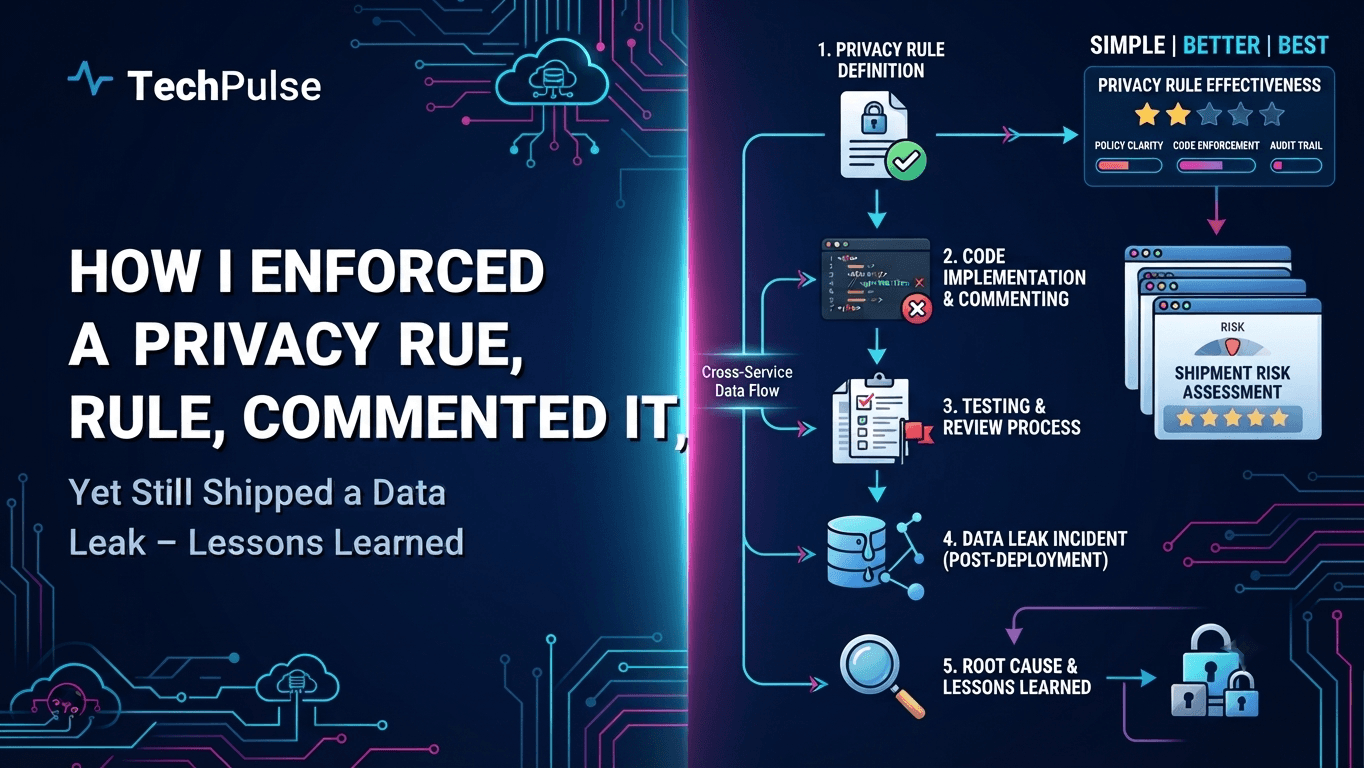
The incident began with a well‑intentioned privacy rule designed to block any export of personally identifiable information. After writing the rule, the team enforced it through automated tests and added extensive comments to document its purpose, believing the safeguard was airtight.
However, a later performance‑driven change introduced a shortcut that inadvertently disabled the rule in the release branch. The oversight slipped through code review, and the build was shipped, exposing user data to external services. This highlights how even documented safeguards can be nullified by unchecked merges or rushed deployments.
To prevent repeat occurrences, organizations must couple static rule enforcement with continuous monitoring, enforce merge‑gate policies, and treat privacy controls as immutable code. Regular audits, automated policy validation, and a culture that prioritises security over speed are essential to protect user trust.
Stay Ahead of the Curve
Subscribe to our newsletter for more deep dives.
Was this architecture guide helpful?
Your feedback calibrates our editorial algorithms.

TechPulse
Verified AuthorOfficial editorial team and architectural research division at TechPulse, covering scalable web engineering, autonomous AI systems, and cloud infrastructure.