Implementing Zero Trust Network Architecture for Secure Cloud Workloads – A Step‑by‑Step Guide
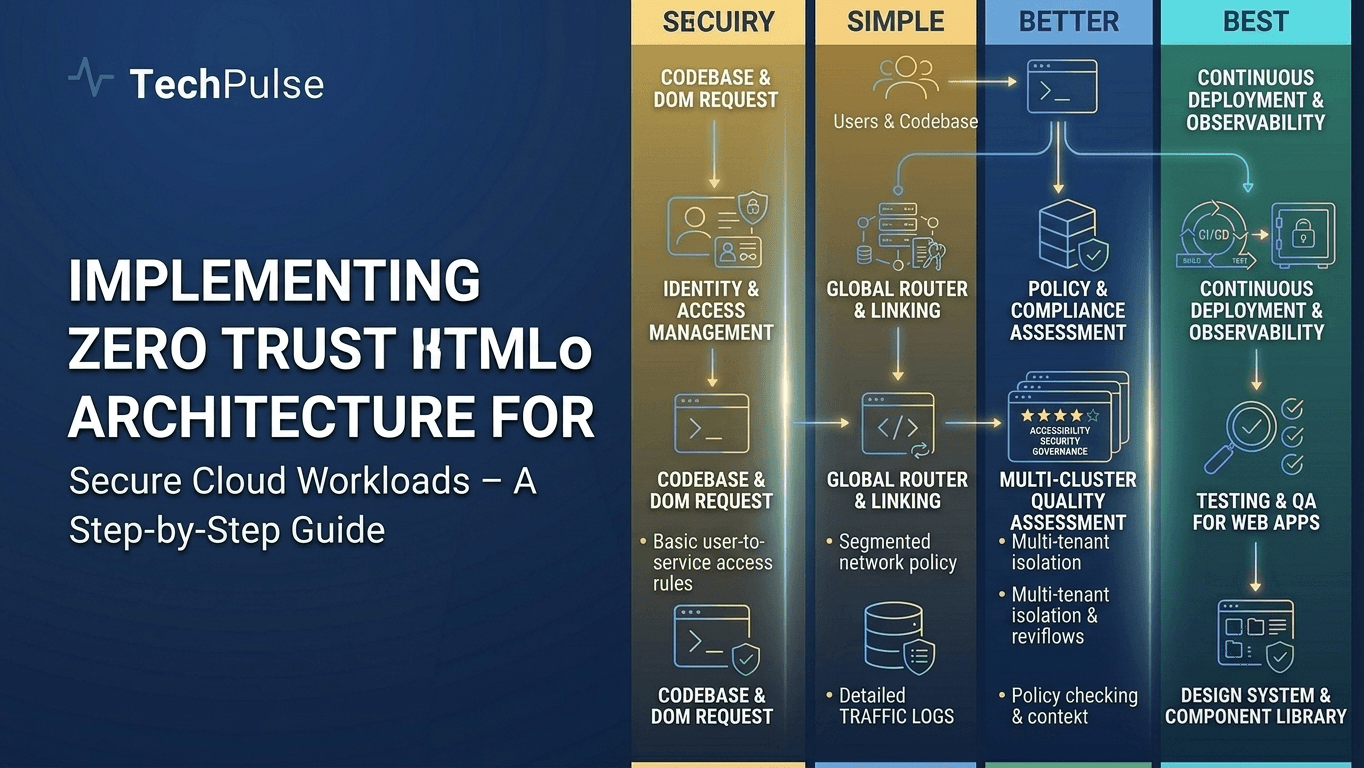
Zero Trust Fundamentals in 2026 Cloud Environments
In 2026, cloud workloads span dozens of public clouds, edge sites, and on‑prem data centers, making the old notion of a hardened perimeter obsolete. Zero Trust Network Architecture (ZTNA) flips that model by assuming every connection, whether internal or external, is untrusted until proven otherwise.
The core Zero Trust principles—verify explicitly, enforce least privilege, and assume breach—are now encoded directly into the cloud control plane, service mesh, and identity providers. By continuously authenticating, authorizing, and inspecting every request, organizations can prevent lateral movement across heterogeneous environments.
Pro Tip
Leverage workload‑specific service mesh sidecars to offload Zero Trust checks, reducing latency compared to centralized proxies.
Warning
Do not rely solely on network‑level segmentation; without identity‑driven policies, compromised pods can still communicate laterally.
Deep Dive Architecture
Policy Decision Point (PDP) runs as a globally distributed, stateless microservice that consumes identity tokens from OIDC providers and emits allow/deny decisions via gRPC.
Policy Enforcement Point (PEP) is embedded in the data plane—e.g., Envoy sidecar or eBPF filter—ensuring decisions are enforced at the packet level before any payload reaches the workload.
| Model | Trust Assumption | Enforcement Location | Typical Tooling |
|---|---|---|---|
| Traditional Perimeter | Trust internal network | Edge firewalls | VPN, ACLs |
| Zero Trust (2019) | Verify each connection | Centralized gateways | SD‑WAN, ZTNA proxies |
| Zero Trust 2026 | Verify continuously, identity‑driven | Distributed PDP/PEP (service mesh, eBPF) | OIDC, SPIFFE, OPA, Envoy |
Pros
- +Reduces attack surface across clouds
- +Enables granular, context‑aware access
- +Improves compliance with automated audit trails
Cons
- -Increases operational complexity
- -Potential latency overhead if not optimized
- -Requires robust identity lifecycle management
Real-World Engineering Examples
- A fintech firm uses Zero Trust to isolate its fraud‑detection microservices across AWS, Azure, and on‑prem, granting access only to services presenting a valid SPIFFE identity and a risk score below 20.
- A media streaming platform enforces Just‑In‑Time access for its transcoding workers, revoking permissions the moment a worker node is patched or shows abnormal CPU usage.
Pro Tip
Zero Trust is no longer optional; it is the foundational security fabric that unifies identity, policy, and enforcement across every cloud workload in 2026.
Core Principles and Their Evolution
Verify Explicitly: Modern workloads rely on machine identities, short‑lived certificates, and risk‑based adaptive authentication, extending beyond static usernames and passwords.
Enforce Least Privilege & Assume Breach: Dynamic policy engines evaluate context (device posture, workload provenance, and real‑time threat intel) to grant just‑in‑time access, and automatically revoke it when anomalies are detected.
AI‑Powered Identity and Access Management (IAM) for Zero Trust
In a Zero Trust paradigm, identity is the new perimeter. Generative AI models combined with continuous behavioral analytics enable a shift from static credentials to a fluid, context‑aware trust fabric. By ingesting telemetry from cloud workloads—API calls, SSH sessions, service‑mesh traffic—AI can construct a probabilistic identity graph that reflects not only who a principal claims to be, but how they *behave* across the ecosystem. This graph feeds directly into policy decision points (PDPs), allowing the system to grant or deny access in milliseconds based on a risk score rather than a binary role.
Adaptive multi‑factor authentication (MFA) is the most visible manifestation of this shift. Instead of prompting every login with a one‑time password, the AI engine evaluates device fingerprint, geolocation, time‑of‑day patterns, and even natural‑language intent extracted from recent ticket comments. If the composite risk stays below a configurable threshold, the session proceeds silently; if it spikes, the user is challenged with a contextual factor—biometric verification, push notification, or a short voice prompt generated on‑the‑fly. The same risk engine enforces least‑privilege by dynamically tightening IAM policies for high‑risk entities, revoking dormant permissions, and surfacing anomalous privilege escalations for manual review.
Pro Tip
Seed your AI models with a month of baseline activity before enabling automated denial; this reduces false positives during the learning phase.
Warning
Never let a single AI score be the sole arbiter of access; always pair it with a manual override path to avoid lock‑out cascades.
Deep Dive Architecture
Event ingestion uses a schema‑registry‑backed Avro format, guaranteeing forward‑compatible data contracts across cloud regions.
Model training runs nightly on a distributed GPU cluster, employing contrastive learning to differentiate legitimate versus anomalous behavior vectors.
| Feature | Traditional IAM | AI‑Powered IAM |
|---|---|---|
| Access decision basis | Static roles & ACLs | Real‑time risk score |
| MFA prompting | Fixed per login | Adaptive, context‑aware |
| Privilege management | Periodic review | Continuous, behavior‑driven |
| Operational overhead | Manual policy updates | Automated model retraining |
Pros
- +Continuous risk assessment
- +Reduced MFA fatigue
- +Adaptive least‑privilege enforcement
Cons
- -Model drift requires ongoing monitoring
- -Increased compute cost
- -Potential privacy concerns with telemetry collection
Real-World Engineering Examples
- A multinational bank integrated OpenAI‑based intent analysis into its IAM pipeline, cutting phishing‑related credential abuse by 73 % within six months.
- A SaaS provider for CI/CD pipelines deployed a TensorFlow risk model that automatically escalates MFA for service accounts exhibiting atypical repo‑clone patterns, preventing a supply‑chain breach.
Pro Tip
AI‑driven IAM turns identity verification into a continuous, data‑rich dialogue, delivering the agility Zero Trust demands while keeping the human safety net firmly in place.
Dynamic Risk Engine Architecture
The core of an AI‑powered IAM system is a streaming risk engine built on event‑driven microservices. Raw telemetry is first normalized by an ingestion layer (Kafka, Pub/Sub), then enriched with identity metadata from directory services. A feature store persists time‑series aggregates—login velocity, API call entropy, token reuse frequency—ready for model inference.
A lightweight inference service hosts a fine‑tuned transformer that outputs a numeric risk score per authentication attempt. The score is consumed by the PDP, which combines it with static policy rules to produce an allow/deny decision. Feedback loops push the outcome back into the training pipeline, enabling continuous learning and drift detection.
Service Mesh Integration for Microservice Zero Trust
Service meshes like Istio and Linkerd have matured to become the de‑facto enforcement layer for Zero Trust in cloud‑native environments, automatically handling mutual TLS (mTLS) and policy enforcement between every pod pair.
By abstracting network security into a control plane that speaks Envoy sidecars, these meshes allow operators to declare fine‑grained, context‑aware policies—such as identity‑based routing, rate limiting, and traffic mirroring—without modifying application code, thereby scaling security across thousands of services.
Pro Tip
Enable automatic mTLS on a namespace‑level to reduce configuration drift and ensure all intra‑cluster traffic is encrypted by default.
Warning
Disabling Istio’s default sidecar injection can expose services to unencrypted traffic; always verify that all workloads are sidecar‑injected before turning off mTLS.
Deep Dive Architecture
Mutual TLS is negotiated at Envoy sidecar handshake, leveraging X.509 certificates signed by a shared CA, with certificate rotation handled by the control plane.
Policy engine (e.g., Istio’s Mixer or Linkerd’s policy API) evaluates expressions against request context—source namespace, user principal, request header—to decide allow/deny.
Traffic encryption at scale is achieved by reusing TLS session tickets and session caching to avoid full handshakes for high‑volume micro‑service calls.
| Tool | mTLS | Policy Granularity | Observability | AI‑Driven Features |
|---|---|---|---|---|
| Istio | Yes | Very high (CRDs) | Rich (Prometheus, Grafana) | Limited (Rule‑based) |
| Linkerd | Yes | High (JSON policy) | Good (Prometheus) | Emerging (AI‑driven routing) |
| AI‑Mesh | Yes | Adaptive (ML‑based) | AI‑enhanced | Full AI control plane |
Pros
- +Zero‑trust enforcement without code changes
- +Built‑in observability and telemetry
- +Extensible policy model via Envoy filters
Cons
- -Operational complexity of managing control plane
- -Potential performance overhead of sidecar proxies
- -Steep learning curve for policy DSLs
Real-World Engineering Examples
- Netflix uses Istio to enforce per‑service authentication and rate limiting across its 500‑service architecture, reducing lateral movement risk.
- GitHub’s internal Linkerd deployment enforces mTLS for all internal services, enabling zero‑trust between micro‑services while keeping latency below 10 ms.
Pro Tip
Integrating a service mesh into your cloud workload stack turns every pod pair into a Zero‑Trust enclave, enabling automated, scalable encryption and policy enforcement that adapts to the evolving threat landscape.
Key Components
Control Plane: orchestrates configuration, aggregates telemetry, and enforces policy via CRDs or API gateways.
Data Plane: Envoy sidecars or proxy proxies that terminate TLS, perform routing, and collect metrics.
eBPF and Kernel‑Level Enforcement in Cloud Workloads
Traditional network security relies on userspace proxies and netfilter chains, introducing context-switch overhead and observable latency spikes. Extended Berkeley Packet Filter (eBPF) fundamentally shifts this paradigm by allowing sandboxed programs to execute directly within the Linux kernel. Security agents leveraging eBPF intercept network packets, system calls, and file operations at the kernel boundary, enabling granular Zero Trust policy enforcement without data plane performance penalties.
By attaching to tracepoints, KPROBEs, and XDP hooks, eBPF programs evaluate traffic against dynamically updated policy maps. This architecture eliminates the need for packet copying across kernel-userspace boundaries, delivering sub-microsecond decision times. Modern cloud-native platforms use this capability to enforce microsegmentation, identity-aware routing, and runtime threat detection natively inside the host OS.
Pro Tip
Pre-compile eBPF programs against target kernel headers and leverage CO-RE to ensure seamless deployment across heterogeneous cluster environments.
Warning
Kernel version fragmentation across cloud instances can cause verifier rejections; maintain a strict kernel pinning strategy or use BPF CO-RE techniques to avoid runtime failures.
Deep Dive Architecture
BPF Verifier performs static analysis to guarantee bounded loops, safe memory access, and register constraints before loading bytecode.
XDP (eXpress Data Path) hooks operate at the network driver level, enabling packet dropping or forwarding before socket allocation.
BPF Maps serve as high-performance, lock-free shared memory structures for cross-program state synchronization and policy caching.
CO-RE leverages libbpf to resolve kernel struct offsets at runtime, ensuring binary compatibility across kernel versions without recompilation.
Pros
- +Sub-microsecond policy evaluation latency
- +Eliminates userspace context-switch overhead
- +Safe sandboxing via kernel verifier
Cons
- -Steep learning curve for BPF bytecode debugging
- -Requires kernel version management or CO-RE support
- -Limited visibility into proprietary vendor kernel patches
Real-World Engineering Examples
- Cilium implements Kubernetes network policy and L7 load balancing entirely via eBPF, replacing iptables and kube-proxy.
- Falco uses eBPF probes to monitor syscall activity and detect anomalous container behavior in real-time.
- Tetragon provides Kubernetes-native runtime security by tracing kernel events and correlating them with pod identities.
Architecture of Kernel-Native Policy Engines
Policy engines compile high-level security rules into eBPF bytecodes, which are validated by the kernel verifier before execution. The verifier guarantees memory safety, prevents infinite loops, and enforces strict resource limits, making eBPF inherently secure for untrusted or dynamically pushed policy updates.
Once verified, programs are JIT-compiled to native machine code and attached to specific kernel hooks. Policy state is maintained in BPF maps, allowing rapid lookups for connection tracking, identity mapping, and rate limiting without blocking critical kernel execution paths.
SASE Platforms: Converging Network and Security for Zero Trust
Secure Access Service Edge (SASE) represents the architectural evolution required to support modern, distributed cloud workloads. By converging SD-WAN with cloud-native security services like CASB and ZTNA, SASE eliminates the performance latency inherent in backhauling traffic to centralized data centers. Traffic terminates at the nearest edge PoP, where policy enforcement occurs dynamically based on identity, device posture, and context.
Market-leading implementations leverage a unified control plane that orchestrates routing optimization alongside continuous security validation. This convergence ensures micro-segmentation policies travel with the packet, enabling strict least-privilege access regardless of user location or workload residency. The architecture shifts the security perimeter from a static network boundary to a fluid, identity-centric model.
Pro Tip
Prioritize vendors exposing open APIs for policy automation. Hardcoding routing rules defeats dynamic cloud scaling and increases operational debt.
Warning
Avoid vendor lock-in by verifying multi-cloud routing support without proprietary appliances. Proprietary overlays hinder hybrid agility and inflate egress costs.
Deep Dive Architecture
Edge PoPs utilize programmable data planes to inspect traffic at line rate without CPU bottlenecks.
Identity-aware proxies intercept outbound requests, injecting JWT tokens and validating against IdPs before allowing cloud API calls.
Centralized telemetry aggregates flow logs, DNS queries, and TLS handshake metadata into a SIEM for real-time anomaly detection.
Pros
- +Eliminates backhaul latency by terminating traffic at edge PoPs
- +Unifies network and security management under a single control plane
- +Scales elastically with cloud workload deployment
Cons
- -High egress costs can accumulate with heavy cloud-to-cloud traffic
- -Complex initial policy migration from legacy perimeter defenses
- -Vendor dependency creates potential single points of failure
Real-World Engineering Examples
- FinTech firms deploying SASE to isolate payment processing microservices while allowing developers secure, context-aware access from remote locations.
- Healthcare networks using SASE edge nodes to enforce HIPAA-compliant data loss prevention policies across distributed telehealth endpoints.
Architectural Integration and Policy Orchestration
Integration relies on standardized APIs that synchronize routing tables with identity providers and threat intelligence feeds. When a workload initiates a connection, the edge gateway evaluates the request against dynamic policies, applying encryption and malware inspection before establishing the session. This inline processing minimizes latency while maintaining Zero Trust compliance.
Zero Trust Data Plane: Secure Service‑to‑Service Communication
In a zero‑trust data plane, all east‑west traffic between cloud workloads is treated as untrusted by default. Rather than relying on legacy VPNs or static IP whitelists, the architecture enforces mutual TLS (mTLS) at the application layer, ensuring that every service communicates only with authenticated peers. Workload certificates, issued by a dedicated Certificate Authority (CA) in the control plane, replace static secrets and enable continuous verification of identity. The combination of mTLS, workload‑level certificates, and secret‑less authentication (e.g., SPIFFE/SVID or JWT) guarantees that even if a pod is compromised, it cannot impersonate another service without possessing a valid, time‑bound certificate. This model eliminates the need to store long‑lived secrets in code or environment variables, thereby closing a major attack vector in cloud-native environments.
The service mesh implements the data‑plane logic via lightweight sidecar proxies that intercept all inbound and outbound traffic. Each sidecar negotiates an mTLS session with its peer, performing certificate validation against the mesh CA and applying fine‑grained access policies defined in the control plane. The mesh automatically rotates certificates on a schedule, revokes compromised ones through CRLs or OCSP, and provides telemetry for every connection. This orchestration ensures that every request is authenticated, encrypted, and logged, enabling auditors to reconstruct traffic flows and detect anomalies in real time.
Zero Trust Policy Automation with GitOps and OPA
Zero Trust Architecture demands that every request, regardless of origin, be authenticated, authorized, and audited. Deploying such policies across a sprawling cloud fleet can become a nightmare without automation. Open Policy Agent (OPA) coupled with GitOps pipelines offers a declarative, version‑controlled, and audit‑ready solution for policy lifecycle management.
OPA’s core is the Rego language, a high‑level, logic‑based DSL that expresses fine‑grained policies as functions and rules. By storing Rego files in a Git repository and wiring them into a CI/CD pipeline, teams can treat policy changes as code: pull requests trigger automated tests, static analysis, and policy simulation before the changes are merged and propagated to all workloads via a sidecar or API gateway.”]
h3
:
OPA Rego in a GitOps Pipeline
sub_paragraphs
:
The typical workflow starts with a developer committing a new Rego file to the policy repo. A CI job runs unit tests written in Rego’s built‑in testing framework, executes integration tests against a sandboxed environment, and feeds the result to a policy simulator that visualizes the impact on existing workloads.
Once the PR is merged, a GitOps operator such as ArgoCD or Flux watches the repo, pulls the latest Rego bundle, and injects it into the OPA sidecar or the ingress gateway. Because the policy is versioned, rollback is as simple as checking out a previous commit and re‑deploying, ensuring compliance and minimizing drift.”]
callout_tip
:
Use Rego
s
Observability and Continuous Verification: AI‑Driven Threat Detection
Zero Trust for cloud workloads hinges on the ability to see every interaction in real time. By streaming telemetry from containers, serverless functions, and service meshes into a unified observability platform, security teams gain a continuous view of identity, device health, and request context. This data flood becomes the raw material for AI models that flag deviations from learned baselines, enabling rapid detection of lateral movement, credential abuse, or compromised workloads.
Continuous verification closes the loop: once an anomaly is flagged, an automated policy engine re‑evaluates the trust posture of the offending entity and can instantly enforce micro‑segmentation or credential revocation. The feedback from enforcement actions is fed back into the telemetry pipeline, allowing the AI to adapt its models and reduce false positives over time.
Pro Tip
Always normalize telemetry to a common time base (e.g., UTC) before feeding it to AI models; mismatched clocks are a common source of false anomalies.
Warning
Neglecting model drift monitoring can cause the detector to miss novel attack patterns or generate excessive noise.
Deep Dive Architecture
Data Ingestion Layer: high‑throughput collectors (OpenTelemetry, Fluent Bit) push protobuf payloads to a Kafka backbone for durability and ordering.
Feature Store & Model Inference: Spark Structured Streaming writes aggregated features to Delta Lake; a TensorFlow Serving endpoint scores each event in sub‑millisecond latency.
| Tool | Telemetry Scope | Native AI Integration | Approx. Cost |
|---|---|---|---|
| OpenTelemetry | Application, Service Mesh, Host | Requires external ML stack | Open source |
| AWS CloudWatch | AWS services, EC2, Lambda | Limited built‑in anomaly detection | Pay‑as‑you‑go |
| Datadog | Full‑stack, Kubernetes, Serverless | Built‑in ML alerts & forecasting | Tiered subscription |
Pros
- +Real‑time detection reduces dwell time.
- +Feedback loop improves model precision.
- +Policy enforcement is automated and auditable.
Cons
- -High volume telemetry can increase storage costs.
- -AI models require expertise to tune and maintain.
- -Potential for false positives if data quality is poor.
Real-World Engineering Examples
- A fintech firm deployed Falco alongside OpenTelemetry on its Kubernetes clusters; the AI engine detected a sudden spike in privileged container exec calls, triggering an automated revocation of the compromised service account.
- A multi‑cloud SaaS provider leveraged Azure Sentinel's built‑in UEBA models to continuously verify API gateway trust levels, automatically isolating a rogue VM that exhibited abnormal outbound traffic to known C2 IPs.
Pro Tip
Embedding AI‑driven anomaly detection within a real‑time observability pipeline creates a self‑healing Zero Trust loop that continuously validates and reinforces the security posture of cloud workloads.
AI‑Powered Anomaly Detection Pipeline
Telemetry collectors (e.g., OpenTelemetry SDKs) emit structured traces, metrics, and logs to a central data lake. A preprocessing layer normalizes timestamps, enriches records with identity tags, and stores them in a time‑series feature store. From there, a streaming inference engine applies unsupervised models—such as Isolation Forests or deep auto‑encoders—to spot outliers in request latency, API call patterns, or resource usage.
When an outlier exceeds a configurable risk threshold, the verification engine triggers a policy evaluation. The result can be a passive alert, a forced re‑authentication, or an immediate network quarantine. The outcome—whether the event was benign or malicious—is recorded, allowing the AI model to be retrained with labeled data, thus continuously sharpening detection accuracy.
Compliance‑as‑Code and Regulatory Automation in Zero Trust
Embedding regulatory requirements directly into infrastructure as code (IaC) turns static checklists into executable policies that can be validated on every commit, build, and deployment. In a Zero Trust model, these policies become the gatekeepers that ensure only compliant workloads are granted access to protected resources.
Tools such as Chef InSpec, Pulumi, and CloudFormation Guard allow teams to codify GDPR, PCI‑DSS, and CMMC controls as reusable modules. By integrating these modules into CI/CD pipelines, compliance checks become automated, version‑controlled, and auditable, eliminating manual gatekeeping and reducing the risk of drift between declared intent and actual runtime state.
Pro Tip
Version your InSpec profiles alongside your IaC code; a git tag on the profile repository can be referenced in the CI pipeline to guarantee exact rule sets are applied.
Warning
Avoid hard‑coding exceptions in Guard rules; doing so creates compliance drift and can silently bypass critical controls.
Deep Dive Architecture
The compliance engine runs in a sandboxed container, loading the IaC artifact (e.g., a CloudFormation template) and executing a suite of InSpec controls that each map to a specific GDPR article or PCI requirement, returning a structured JSON report.
OPA integrates the compliance JSON report as input to its policy bundle, where Rego rules translate compliance status into network admission decisions, effectively binding regulatory compliance to Zero Trust access enforcement.
| Tool | Language | Primary Use‑Case | Integration |
|---|---|---|---|
| Chef InSpec | Ruby DSL | Write test‑style controls for GDPR/PCI | CI pipelines, OPA |
| Pulumi | TypeScript/Python/Go | Define cloud resources with embedded policy checks | Directly in IaC code |
| CloudFormation Guard | YAML | Guard rules for AWS CloudFormation & CDK | Pre‑deployment validation |
Pros
- +Automated, repeatable compliance checks reduce human error.
- +Policy versioning aligns regulatory updates with code releases.
- +Immediate enforcement integrates compliance with Zero Trust access decisions.
Cons
- -Initial effort to translate complex regulations into code.
- -Potential performance overhead during CI pipeline execution.
- -Requires ongoing maintenance as standards evolve.
Real-World Engineering Examples
- A multinational SaaS provider uses InSpec to encode GDPR data‑minimization rules; any EC2 instance that declares an unencrypted EBS volume is automatically blocked by the Zero Trust gateway.
- A payment processor leverages CloudFormation Guard to enforce PCI‑DSS encryption‑at‑rest requirements on S3 buckets; non‑compliant stacks trigger a rollback and an automated ticket in ServiceNow.
Pro Tip
By codifying regulatory controls with tools like InSpec, Pulumi, and CloudFormation Guard, organizations turn compliance into an automated, enforceable layer of Zero Trust, ensuring that only workloads meeting legal standards ever obtain network access.
Embedding Policy as Code into Zero Trust Pipelines
A typical pipeline starts with source code checkout, proceeds through a build stage that generates IaC artifacts, and then invokes a compliance‑as‑code engine. The engine evaluates the artifacts against a library of InSpec profiles or Guard rules that map directly to regulatory controls. Only when the evaluation returns a clean pass does the Zero Trust policy engine inject the workload into the service mesh with appropriate identity and access policies.
Because the compliance outcome is a binary signal, it can be consumed by policy decision points (PDPs) such as Open Policy Agent (OPA) or native cloud identity services. This tight coupling ensures that a workload that fails a PCI check never receives a network permit, enforcing Zero Trust at the moment of deployment.
Future Roadmap: Quantum‑Resistant Zero Trust and Edge Computing
Quantum computers, once they achieve practical scale, will render RSA, ECC, and many current TLS ciphers obsolete. Zero Trust Network Architecture (ZTNA) for cloud workloads must therefore adopt quantum‑safe primitives before 2027 to preserve the confidentiality and integrity of authentication tokens, service‑mesh traffic, and data‑in‑motion. The NIST Post‑Quantum Cryptography (PQC) standardization process has already elevated algorithms such as CRYSTALS‑Kyber (key‑encapsulation) and CRYSTALS‑Dilithium (digital signatures) to finalist status. Embedding these algorithms into the Zero Trust trust‑anchor—identity providers, policy decision points, and workload certificates—creates a quantum‑resistant trust fabric. Hybrid handshakes that pair classic ECDHE with Kyber allow a graceful migration path, while still protecting legacy clients. However, the larger key sizes (up to several kilobytes) and increased handshake latency demand careful bandwidth budgeting, especially for edge‑proxied workloads that operate under strict latency SLAs.
Confidential computing adds hardware‑rooted attestation and memory encryption, ensuring that even a compromised hypervisor cannot read workload secrets. When combined with edge‑native Zero Trust, where policy enforcement is pushed to micro‑data‑centers and 5G base stations, the attack surface shrinks dramatically. Edge devices can host lightweight enclaves that perform mutual attestation using PQ signatures, then fetch zero‑trust policies from a central control plane encrypted with post‑quantum key‑exchange. This model enables on‑device decision making—allowing a sensor to verify its own integrity and the integrity of the downstream service before any data leaves the premises. By 2027, we anticipate a convergence of PQC, confidential enclaves (e.g., Intel SGX, AMD SEV‑SNP, ARM TrustZone), and decentralized policy distribution (e.g., SPIFFE bundles) to form an “Edge‑First Quantum‑Resistant Zero Trust” stack that scales across multi‑cloud and sovereign cloud environments.
Pro Tip
Begin migrations with hybrid PQ/TLS handshakes; they provide immediate quantum‑resilience without breaking existing clients.
Warning
Post‑quantum algorithms increase CPU and memory consumption—validate performance on your edge nodes before full rollout.
Deep Dive Architecture
Hybrid Handshake Layer: The client initiates a TLS 1.3 handshake that bundles an ECDHE key exchange with a Kyber KEM. The server responds with both shares, and the final shared secret is derived by concatenating the classic and post‑quantum components, then hashing.
Attestation‑Bound Policy Tokens: After successful enclave attestation, the control plane issues a JWT whose signature uses Dilithium and whose payload is encrypted with a Kyber‑derived symmetric key, ensuring both authenticity and confidentiality against quantum adversaries.
| Solution | Post‑Quantum Readiness | Performance Impact | Maturity |
|---|---|---|---|
| Hybrid PQ/TLS | High (supports classic + PQ) | Moderate (extra round‑trip) | Growing |
| Pure PQ TLS | Full (only PQ ciphers) | High (larger payloads) | Early |
Pros
- +Quantum‑level confidentiality for identity and data-in‑motion
- +Hardware‑rooted attestation eliminates hypervisor‑level threats
- +Hybrid approach eases migration without service disruption
Cons
- -Larger key sizes increase bandwidth usage
- -CPU overhead can degrade performance on low‑power edge devices
- -Standards and tooling are still maturing, leading to integration complexity
Real-World Engineering Examples
- A multinational IoT platform deployed edge gateways in Europe that run SGX enclaves. Each gateway uses Kyber‑based TLS to communicate with the central policy engine, achieving sub‑50 ms handshake latency despite the larger key sizes.
- A financial services firm migrated its internal service mesh to hybrid PQ/TLS, reducing the risk of future quantum attacks while maintaining compliance with PCI‑DSS. The migration was orchestrated via a GitOps pipeline that auto‑generates Dilithium certificates for each microservice.
Pro Tip
By aligning post‑quantum cryptography, confidential computing, and edge‑first policy enforcement, organizations can future‑proof their Zero Trust posture against quantum threats while preserving the low‑latency guarantees essential for modern cloud workloads.
Core Components of a Quantum‑Resistant Edge‑First Zero Trust Stack
1️⃣ Post‑Quantum Identity Fabric – Identity providers issue certificates signed with Dilithium, and service meshes negotiate Kyber‑based session keys. This fabric underpins every trust decision, from API gateway authentication to inter‑pod mTLS.
2️⃣ Confidential Edge Enclaves – Workloads run inside TEEs that expose attestation APIs. The enclave presents a PQ‑signed attestation report to the policy engine, which then provisions fine‑grained access tokens encrypted with a quantum‑safe cipher suite.
Frequently Asked Questions
What is Zero Trust Network Architecture?
How does micro‑segmentation enhance security for cloud workloads?
What are the key steps to implement Zero Trust in a multi‑cloud environment?
Conclusion & Next Steps
Implementing Zero Trust Network Architecture for cloud workloads transforms security from a perimeter‑based mindset to a data‑centric, identity‑driven approach, ensuring every request is authenticated, authorized, and encrypted regardless of its origin.
By leveraging micro‑segmentation, robust identity management, and continuous verification, organizations can dramatically reduce attack surfaces, prevent lateral movement, and meet compliance requirements while maintaining the agility of cloud‑native operations.
Adopting ZTNA is not a one‑time project but an ongoing discipline that integrates with DevSecOps pipelines, automated policy engines, and real‑time analytics, delivering resilient, future‑proof protection for today’s dynamic cloud workloads.
Stay Ahead of the Curve
Subscribe to our newsletter for more deep dives.
Was this architecture guide helpful?
Your feedback calibrates our editorial algorithms.
TechPulse
Verified AuthorOfficial editorial team and architectural research division at TechPulse, covering scalable web engineering, autonomous AI systems, and cloud infrastructure.