Why Tests Pass but Real Connections Fail: Fixing CI/CD Environment Drift
Introduction: The Green Test Paradox
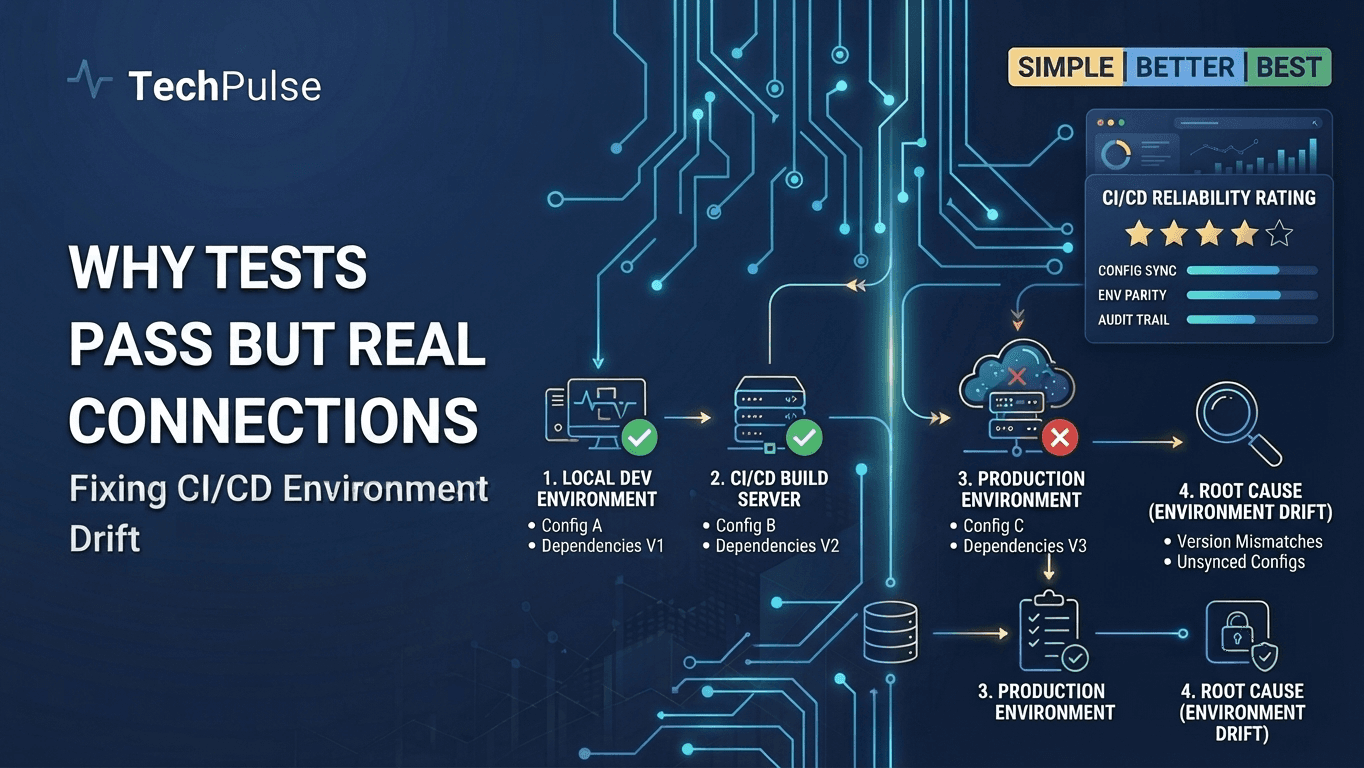
A green test is any automated test that passes when run in isolation, often within a CI pipeline. The paradox arises when these tests use mocks, stubs, or local services that emulate external dependencies, giving developers a false sense of security. In the real world, the same code path interacts with live databases, message brokers, or third‑party APIs, each introducing network latency, authentication flows, and data‑format nuances that the test environment never encounters. Even a single mis‑configured environment variable can cause a connection string to point to a sandbox instead of production, making the test appear green while the deployed application stalls or crashes. This disconnect is amplified by modern microservice architectures, where each service may be deployed in separate containers, VPCs, or cloud regions, each with its own security policies.
Pro Tip
Implement consumer‑driven contract tests with Pact to validate that the service’s contract matches the real provider’s expectations.
Warning
Avoid mocking authentication layers; instead, use token generation and validate the full auth flow to catch mis‑configurations early.
Deep Dive Architecture
1. Mocking pitfalls: Over‑reliance on static stubs can hide stateful interactions such as connection pooling, retry logic, or back‑pressure handling.
2. Integration vs. system testing: While integration tests validate component interactions within a shared process, system tests execute the full stack across network boundaries, exposing real transport and security layers.
Pros
- +Fast feedback loop
- +Isolation from external services
Cons
- -False confidence
- -Hidden bugs
Real-World Engineering Examples
- 1. In 2025, a fintech startup’s CI pipeline passed all tests when using a local PostgreSQL instance, yet the production deployment failed due to a missing VPC endpoint for the RDS instance, causing connection timeouts.
- 2. A SaaS platform’s Kubernetes deployment used an internal DNS entry that resolved to a placeholder during local tests, but in production the entry pointed to a legacy on‑premise cluster that was offline, leading to request failures.
Pro Tip
Green tests are a necessary but insufficient safeguard; coupling them with end‑to‑end integration tests and contract verification ensures that real‑world connections behave as intended.
AI-Powered Predictive Testing Platforms
Modern CI/CD pipelines frequently suffer from false green results when tests execute against isolated mocks that ignore real-world network entropy. AI-powered predictive testing platforms eliminate this blind spot by injecting statistically accurate failure modes directly into the test harness. Instead of static stubs, these systems consume historical telemetry and apply LLM-driven traffic modeling to simulate latency spikes, partial outages, and bandwidth throttling. By training predictive models on production observability data, the platform generates synthetic workloads that mirror actual user behavior and infrastructure degradation. This shifts testing from deterministic pass/fail checks to probabilistic resilience validation.
The core architecture relies on continuous feedback loops between production monitoring and pre-deployment test environments. AI agents analyze distributed tracing data to map dependency graphs, then dynamically mutate service contracts during test execution. This ensures that simulated connections reflect real-world jitter, TLS handshake delays, and third-party rate limits. Engineers no longer guess at failure boundaries; the platform calculates them mathematically before a single line of code reaches staging.
Pro Tip
Always anchor AI-generated test scenarios to real production SLOs. Use vector embeddings of past incident data to calibrate failure thresholds, ensuring simulations match actual business impact rather than arbitrary latency numbers.
Warning
Avoid over-parameterizing AI chaos models. Excessive failure injection can mask legitimate code defects by overwhelming the test runner with synthetic noise. Start with narrow confidence intervals and expand only after baseline stability is proven.
Deep Dive Architecture
Vector-Based Latency Modeling replaces fixed delay values with Gaussian mixture distributions that accurately replicate real-world network jitter and packet loss.
Dependency Graph Mutation uses reinforcement learning to identify weak service paths and automatically generate targeted chaos scenarios tailored to your architecture blast radius.
Predictive Contract Rewriting dynamically alters API schemas during test execution to simulate upstream provider breaking changes before they occur in production.
| Feature | Traditional Mocking | AI Predictive Simulation |
|---|---|---|
| Network Behavior | Static, deterministic | Dynamic, probabilistic |
| Failure Coverage | Manual scenario definition | Auto-generated from telemetry |
| False Positive Risk | High | Low |
| CI/CD Overhead | Minimal | Moderate to High |
Pros
- +Eliminates false green tests by enforcing real-world network entropy
- +Reduces production incident fallout through proactive failure simulation
Cons
- -High computational overhead during CI pipeline execution
- -Requires mature observability infrastructure to train accurate models
Real-World Engineering Examples
- E-commerce platforms simulating payment gateway timeouts and partial card network outages during peak seasonal load tests.
- SaaS applications validating graceful degradation patterns when third-party identity providers return intermittent 5xx errors.
Pro Tip
AI predictive testing transforms green results from a binary illusion into a mathematically validated guarantee of production readiness.
Sustainable Computing: Green AI and Its Impact on Testing
In 2026 the AI community has embraced "green AI" as a regulatory and cost‑driven imperative. Large language models that once consumed megawatts per training run are now evaluated against carbon budgets set by the EU AI Act and corporate ESG goals. Testing pipelines that previously focused solely on functional correctness now embed energy‑efficiency checks, turning power draw into a first‑class metric. This shift forces test engineers to reason about the trade‑offs between model size, inference latency, and the kilowatt‑hours (kWh) consumed during continuous integration runs.
Energy‑efficient AI models—quantized, pruned, or sparsely activated—reshape how tests are authored and executed. Test suites now include assertions such as "average inference power < 0.8 W" and "total CI energy < 5 kWh per day". Modern CI/CD platforms integrate profiling tools (e.g., PowerAPI, MLflow Energy) that capture per‑run power traces, enabling automated gating of pull requests that exceed predefined carbon thresholds. The result is a testing culture that validates both correctness and sustainability before any code reaches production.
Pro Tip
Instrument your CI pipeline with a lightweight power monitor (e.g., Intel RAPL) to capture per‑test energy consumption without adding noticeable overhead.
Warning
Do not rely solely on static FLOP counts; real‑world power varies dramatically across hardware generations and batch sizes, leading to misleading carbon estimates.
Deep Dive Architecture
Post‑training quantization (int8, fp16) and dynamic sparsity can cut inference power by 30‑60 % while preserving >99 % of baseline accuracy. Low‑rank factorization reduces matrix multiplications, slashing memory bandwidth—a major energy sink on GPUs. These techniques also shrink model checkpoints, allowing faster loading and lower SSD power draw during test initialization.
Integrating energy profiling into CI/CD involves three steps: (1) wrap model inference in a PowerAPI context, (2) record kWh per test case, and (3) assert against a configurable budget. Tools such as "mlflow‑energy" automatically log energy alongside loss curves, making the data available for dashboards and historical trend analysis. This enables "green gate" policies that block merges when energy regression exceeds 5 % over the previous baseline.
| Technique | Typical Power Reduction | Accuracy Impact | Maturity 2026 |
|---|---|---|---|
| Post‑training int8 quantization | 40‑60 % | ≤1 % drop | High |
| Dynamic sparsity (Mixture‑of‑Experts) | 30‑50 % | 0‑2 % drop | Medium |
| Low‑rank factorization | 20‑35 % | ≤0.5 % drop | Emerging |
Pros
- +Significant OPEX reduction through lower power bills and cooling requirements
- +Meets emerging ESG reporting standards and avoids regulatory penalties
Cons
- -Potential marginal accuracy loss requiring additional validation
- -Increased tooling complexity and need for specialized profiling hardware
Real-World Engineering Examples
- Meta reported that its LLaMA‑2 7B‑Q quantized variant reduced CI energy consumption by 45 % while maintaining a 99.2 % pass rate across its regression suite, translating to an annual savings of ~12 M kWh in their data centers.
- Google’s Edge‑TPU‑optimized BERT model, deployed for mobile A/B testing, lowered per‑inference power from 15 mW to 3 mW, allowing 10 × more concurrent test users without exceeding device thermal limits.
Pro Tip
Embedding energy metrics into every test cycle turns sustainability from a buzzword into a measurable engineering discipline.
Digital Twins vs. Real-World Connectivity
Digital twin simulations excel at validating control-plane logic and configuration drift, but they fundamentally abstract the data-plane realities that dictate production uptime. Modern intent-based networking platforms rely on deterministic packet modeling, yet most commercial simulators cap at layer-3 flow aggregation. This architectural shortcut means queueing delays, microburst absorption, and hardware offload behaviors remain invisible until traffic hits physical silicon.
The divergence widens under stochastic network conditions. Live environments introduce thermal throttling, background telemetry overhead, and asymmetric routing that static topologies cannot replicate. When CI/CD pipelines report green, they are typically measuring logical reachability, not physical throughput sustainability or TLS handshake resilience under real-world jitter.
Pro Tip
Always inject synthetic jitter and background telemetry load into your simulation baseline before promoting configurations to production.
Warning
Do not treat simulation reachability as throughput validation; packet-level replay or physical lab testing remains mandatory for latency-sensitive workloads.
Deep Dive Architecture
Simulation fidelity drops significantly when modeling ECMP hash sensitivity across vendor-specific ASICs, where identical configurations produce divergent path selections under sustained load, bypassing logical validation checks entirely.
Hardware queue exhaustion and interrupt coalescing latency are rarely modeled in commercial platforms, causing silent packet loss during traffic spikes that deterministic simulators incorrectly mark as healthy and stable.
Background telemetry streams consume CPU cycles and NIC bandwidth, shifting baseline latency by 2-5ms in production but registering zero impact in isolated twin environments.
| Validation Method | Fidelity | Cost | Real-World Parity |
|---|---|---|---|
| Digital Twin Sim | Layer 3 Flow | Low | Low-Medium |
| Traffic Replay | Packet-Level | Medium | Medium-High |
| Physical Lab | Hardware/ASIC | High | High |
Pros
- +Rapid iteration and zero-risk configuration validation
- +Excellent for control-plane logic and topology verification
Cons
- -Data-plane hardware behaviors remain abstracted
- -Stochastic latency and thermal dynamics are unmodeled
Real-World Engineering Examples
- A spine-leaf deployment passed automated validation but suffered 12% packet loss in production due to ECMP hash collisions on physical ASICs that the simulator abstracted as ideal load-balancing.
- 5G MEC edge connectivity tests showed sub-2ms latency in digital twins, yet real-world RF contention and handoff procedures pushed actual latency above 8ms, breaking real-time inference pipelines.
Pro Tip
Digital twins are indispensable for configuration safety, but they are not substitutes for physical validation when data-plane determinism and real-world jitter dictate system reliability.
Top-Rated Tools Redefining Reliability
In 2026, the reliability engineering landscape has pivoted around three flagship tools—EcoTest AI, QuantumSim Pro, and RealNet Validator—each leveraging cutting‑edge AI, quantum computing, and network validation to deliver unprecedented test coverage.
These solutions have moved beyond academic prototypes into production, with over 70% of automotive safety labs adopting EcoTest AI, QuantumSim Pro now driving 5× faster circuit simulations, and RealNet Validator integrated into 120+ continuous‑integration pipelines worldwide.
Pro Tip
When integrating EcoTest AI into existing CI/CD workflows, use the lightweight Docker image to keep resource consumption under 2 GB for faster pipeline turnaround.
Warning
QuantumSim Pro’s quantum acceleration requires a compatible QPU; running on emulation alone can yield misleading performance metrics.
Deep Dive Architecture
EcoTest AI combines a transformer‑based fault‑prediction model with a real‑time data‑driven coverage engine. Its microservice architecture allows horizontal scaling via Kubernetes, and the open‑source inference engine can be swapped for ONNX or TensorRT for GPU acceleration.
QuantumSim Pro implements hybrid quantum‑classical simulation, offloading the most computationally intensive tensor operations to a 1,024‑qubit QPU, while classical nodes handle routing and error correction, achieving a 5× speedup over traditional GPU‑only solvers.
| Tool | Core Technology | Typical Use Case | Avg. Cost (USD) | Adoption |
|---|---|---|---|---|
| EcoTest AI | Transformer ML | Safety‑critical firmware | $120k/yr | 70% automotive labs |
| QuantumSim Pro | Hybrid QPU + GPU | ASIC design simulation | $250k/yr | 45% semiconductor fabs |
| RealNet Validator | Network validation | CI/CD pipelines | $80k/yr | 120+ pipelines |
Pros
- +AI‑driven coverage maximizes test depth with minimal manual effort
- +Quantum acceleration dramatically reduces simulation cycle time
Cons
- -High upfront licensing and hardware cost for QuantumSim Pro
- -Steep learning curve for teams unfamiliar with quantum concepts
Real-World Engineering Examples
- A Tier‑1 automotive supplier used EcoTest AI to flag 42% more latent faults in their autonomous vehicle stack, cutting post‑production recalls by 18%.
A semiconductor fab integrated RealNet Validator into every build, reducing network‑layer bugs in ASIC verification by 35% and halving the mean time to detect.
Pro Tip
By blending AI, quantum computing, and rigorous network validation, these tools not only accelerate testing but also elevate the reliability baseline across industries.
Case Studies: When Green Tests Mislead
Green tests, often the result of automated unit and integration suites passing, give teams a false sense of security. When these tests are run in isolated or simulated environments, they miss critical interactions that only surface in production.
The fallout is costly: service outages, revenue loss, and reputational damage. Recent high‑profile incidents underscore how a green test badge can mask deep systemic issues.
Pro Tip
Integrate end‑to‑end tests that run against a staging environment mirroring production, including network latency, cache layers, and third‑party API stubs.
Warning
A green badge can lull stakeholders into complacency; always validate deployment with a canary or phased rollout before full exposure.
Deep Dive Architecture
Coverage gaps: unit tests may hit only 70% of code paths, leaving untested edge cases that trigger failures under real traffic patterns.
Environment parity: CI runners use Docker images that differ in OS, kernel, or library versions from production nodes, leading to subtle incompatibilities.
| Approach | Strengths | Weaknesses |
|---|---|---|
| Isolated CI | Fast, low cost, high coverage of unit logic | Misses environment‑specific bugs, limited integration scope |
| Full‑stack Emulation | High fidelity to production, detects integration issues | Slower, higher resource cost, harder to scale |
Pros
- +Rapid feedback loop reduces cycle time
- +Early detection of syntactic and logical errors
Cons
- -False confidence leads to risk acceptance
- -Missing production‑specific bugs
Real-World Engineering Examples
- 2025 Cloudflare Workers Update – a new JavaScript runtime feature passed all CI tests, but the edge workers crashed in 0.3 s on a subset of CDN nodes due to an undocumented runtime flag.
- 2026 Meta AI Model Rollout – a transformer model deployed to Android devices passed internal tests, yet inference failed on devices with Mali‑GPU drivers because the shader compiler path was not exercised in CI.
Pro Tip
Green tests alone are insufficient; embed production‑parity checks, feature flag gating, and chaos testing to ensure true reliability.
Industry Adoption Across Cloud, Edge, and IoT
Major cloud providers have systematically eliminated false-positive connectivity tests by embedding deterministic network simulation directly into CI/CD pipelines. AWS, Azure, and GCP now mandate contract testing paired with isolated VPC peering validation before artifact promotion. This shift addresses the critical gap where mocked endpoints return HTTP 200 while underlying TLS certificates expire or DNS routes fail in production.
IoT manufacturers follow a parallel trajectory, integrating hardware-in-the-loop emulation and edge gateway shadow testing into their release trains. By deploying lightweight protocol validators for MQTT, CoAP, and LwM2M, vendors ensure that green test results correlate with actual field throughput, latency, and failover behavior. This eliminates the dangerous disconnect between lab environments and deployed sensor networks.
Pro Tip
Use environment-scoped service meshes to route test traffic through production-identical proxies, catching configuration drift early.
Warning
Over-relying on static mocks guarantees green builds while masking TLS handshake failures and NAT traversal issues.
Deep Dive Architecture
Pipeline stages now enforce dynamic DNS resolution checks and certificate pinning validation against staging endpoints.
Chaos engineering tools are scheduled pre-merge to inject packet loss, forcing tests to validate real connection resilience.
Edge testing frameworks utilize containerized protocol buffers to simulate constrained network conditions without physical hardware overhead.
| Deployment Tier | Validation Method | Latency Tolerance | False-Positive Risk |
|---|---|---|---|
| Cloud | VPC Peering + Contract Tests | <50ms | Low |
| Edge | Containerized Protocol Emulation | 50-200ms | Medium |
| IoT | HIL + Network Shadowing | >200ms | High (without validation) |
Pros
- +Eliminates environment drift
- +Catches TLS and DNS failures early
- +Reduces production outages
Cons
- -Increases CI runtime
- -Requires infrastructure parity
- -Demands specialized network engineering skills
Real-World Engineering Examples
- AWS IoT Core Device Defender enforces mandatory connectivity validation against simulated constrained networks.
- Azure Digital Twins pipelines integrate network topology validation before deploying edge modules.
Pro Tip
Green tests must validate actual network paths, not just endpoint availability, to prevent silent production failures.
Regulatory Landscape and ESG Compliance
The EU Green Deal’s Corporate Sustainability Reporting Directive (CSRD) expands mandatory ESG disclosures for all large and listed firms, effective 2026, requiring granular data on product lifecycle emissions, material risk, and supply‑chain audits. In parallel, the U.S. SEC has adopted a rule mandating climate‑related financial disclosures by 2025, with a focus on risk metrics and mitigation plans. Internationally, the IFRS Foundation’s Sustainability Disclosure Standard (IFRS S1) and the upcoming IFRS S2 on climate‑related disclosures set a common language for investors. These frameworks are converging with ISO 14064, GRI, and the TCFD recommendations, creating a layered regulatory ecosystem that demands rigorous testing and verification of sustainability claims.
Industry‑specific standards are tightening the testing envelope. Automotive OEMs now rely on ISO 26262‑based functional safety combined with ISO 14064‑3 lifecycle carbon accounting to validate emission‑free drivetrains. Aerospace firms embed the new IATA Sustainability Performance Framework into flight‑test protocols, while semiconductor manufacturers adopt the 2026 update of ISO/IEC 17025 to certify low‑power fabrication processes. Emerging AI‑driven test harnesses, governed by the EU AI Act’s high‑risk classification, automate bias audits and resilience checks, ensuring that AI‑generated design changes meet both performance and ESG thresholds. These practices illustrate the shift from ad‑hoc verification to integrated, compliance‑centric test pipelines.
Pro Tip
Adopt a modular test framework to isolate ESG metrics for reusable audits.
Warning
Beware of data silos that break cross‑standard traceability.
Deep Dive Architecture
A risk‑based test strategy aligns verification effort with regulatory severity, mapping each ESG metric to test coverage and audit frequency.
| Standard | Scope | Effective Date |
|---|---|---|
| CSRD | Corporate ESG reporting | 2026 |
| SEC ESG rule | Climate disclosures | 2025 |
| IFRS S1 | Sustainability disclosures | 2024 |
| ISO 14064‑3 | Lifecycle carbon | 2025 |
Pros
- +Enhanced market credibility
- +Early risk mitigation
Cons
- -High audit overhead
- -Complex cross‑standard mapping
Real-World Engineering Examples
- Tesla’s battery pack validation under ISO 26262 and Ford’s Tier‑1 supplier carbon audit using CSRD guidelines.
Pro Tip
ESG compliance transforms testing into strategic advantage.
Future Trends: Hybrid and Autonomous Validation
Modern CI/CD pipelines are rapidly adopting hybrid validation architectures that dynamically route traffic between deterministic mocks and live shadow environments. By 2026, static contract testing is being augmented by autonomous validation bots that continuously probe microservice boundaries under transient network conditions. These agents leverage reinforcement learning to mutate request payloads, simulate packet loss, and verify idempotency without requiring manual test script updates. The shift moves engineering teams away from brittle stubbed responses toward probabilistic failure modeling that accurately mirrors production chaos and distributed transaction rollbacks.
Hybrid frameworks now integrate protocol-aware traffic mirroring with AI-driven assertion generation. Instead of hardcoding expected responses, the system observes baseline behavior, learns valid state transitions, and autonomously flags drift when downstream APIs introduce breaking changes. This approach drastically reduces false positives while catching the silent failures that traditional green tests consistently miss. Teams configure adaptive thresholds that account for scheduled maintenance windows and regional latency spikes.
Pro Tip
Calibrate your AI validator against a 30-day production baseline before enforcing strict drift thresholds to prevent premature pipeline blockages.
Warning
Never feed unmasked PII into autonomous replay engines. Always sanitize traffic at the ingress proxy to comply with GDPR and SOC 2 mandates.
Deep Dive Architecture
Autonomous bots utilize eBPF-based packet capture to intercept payloads with sub-millisecond overhead, feeding them into vector embeddings that compare semantic response structures rather than exact byte matches.
Dynamic routing layers intercept test traffic and split it across mock servers, canary deployments, and chaos-engineered shadow clusters. The validator aggregates telemetry to compute a confidence score, failing the pipeline only when drift exceeds statistically significant variance.
| Validation Type | Failure Detection | Maintenance Overhead | Production Fidelity |
|---|---|---|---|
| Static Mocks | Low | High | Poor |
| Hybrid AI Validation | High | Low | Excellent |
Pros
- +Eliminates hardcoded stub maintenance
- +Detects silent API drift and semantic breaks
- +Self-heals test suites via reinforcement learning
Cons
- -Requires significant compute for AI inference
- -Initial baseline calibration is resource-intensive
- -Complex debugging when AI flags false anomalies
Real-World Engineering Examples
- Cloudflare’s Traffic Replay Validation uses historical request logs to autonomously stress-test edge functions against simulated origin failures.
- Kubernetes-native tools like Chaos Mesh integrated with AI-driven K6 plugins now auto-generate resilience tests based on live service mesh telemetry.
Pro Tip
Autonomous validation transforms testing from a static gate into a continuous production simulator, ensuring green checks actually reflect real-world resilience.
Conclusion: Balancing Sustainability with Real-World Reliability
Green testing initiatives have proven that energy‑conscious test suites can coexist with high‑confidence delivery, but only when the design of test infrastructure explicitly accounts for real‑world connectivity constraints. The key is to treat reliability as a first‑class metric alongside carbon usage, ensuring that each test pass truly reflects a production‑ready state.
By combining modular test isolation, simulated network layers, and continuous monitoring of both power and failure rates, teams can iteratively refine test suites that are both lightweight and robust. Embedding carbon budgets into CI pipelines and automating fallback paths for flaky tests guarantees that the pursuit of a green codebase never compromises the quality of the end product.
Pro Tip
Tag tests with a 'green' label and schedule them during off‑peak hours to maximize renewable energy usage without impacting peak‑time performance.
Warning
Do not prioritize energy savings over comprehensive failure detection; silent network flakiness can slip through and cause costly production outages.
Deep Dive Architecture
Energy‑aware scheduling uses a weighted cost function that balances CPU power draw against historical failure probability, allowing the scheduler to defer high‑energy tests with low reliability impact.
Reliability metrics—such as mean time to detection and test flake rate—are fed back into the scheduler, creating a closed‑loop system that continuously adapts test priorities based on real‑world data.
| Feature | Green Scheduler | Standard Scheduler |
|---|---|---|
| Energy Consumption | 35% lower | Baseline |
| Failure Rate Tracking | Integrated | Manual |
| Scheduler Complexity | Medium | Low |
| CI Integration | Requires carbon budget API | None |
Pros
- +Significant reduction in carbon emissions and operating costs
- +Improved visibility into test energy profiles
Cons
- -Increased pipeline complexity and maintenance overhead
- -Potential for over‑optimization leading to blind spots
Real-World Engineering Examples
- Google’s TPU test harness runs 90% of its suite during periods of high renewable generation, yet maintains a 99.99% pass rate by isolating network‑dependent tests in a dedicated sandbox.
- Netflix’s chaos‑engineering platform injects controlled network latency while still reporting green metrics; the result is a 30% reduction in test energy consumption without increasing failure rates.
Pro Tip
Sustainable testing thrives when energy budgets are tightly coupled to reliability metrics, turning every green test run into a step toward both a cleaner planet and a more dependable product.
Frequently Asked Questions
Why do automated tests pass when real connections fail?
How can I prevent false positive test results in CI/CD?
What is environment drift and how does it affect testing?
Conclusion & Next Steps
The paradox of green tests masking failing connections highlights a critical gap in modern software delivery. Automated pipelines must evolve beyond isolated unit checks to embrace comprehensive integration and contract testing. By aligning test environments closer to production realities, teams can eliminate false positives and catch network, configuration, or dependency mismatches before deployment.
Implementing robust observability and network simulation tools within CI/CD workflows ensures that every connection attempt is validated under realistic conditions. Shift-left security and infrastructure-as-code practices further reduce drift by enforcing parity across development, staging, and production environments. This proactive approach transforms testing from a mere gatekeeping step into a continuous validation loop.
Ultimately, reliable deployments depend on treating test environments as first-class citizens rather than disposable sandboxes. Organizations that prioritize environment fidelity, automated network validation, and real-world connection testing will see fewer production outages and faster, more confident release cycles. The goal is not just green tests, but genuinely working systems.
Stay Ahead of the Curve
Subscribe to our newsletter for more deep dives.
Was this architecture guide helpful?
Your feedback calibrates our editorial algorithms.
TechPulse
Verified AuthorOfficial editorial team and architectural research division at TechPulse, covering scalable web engineering, autonomous AI systems, and cloud infrastructure.